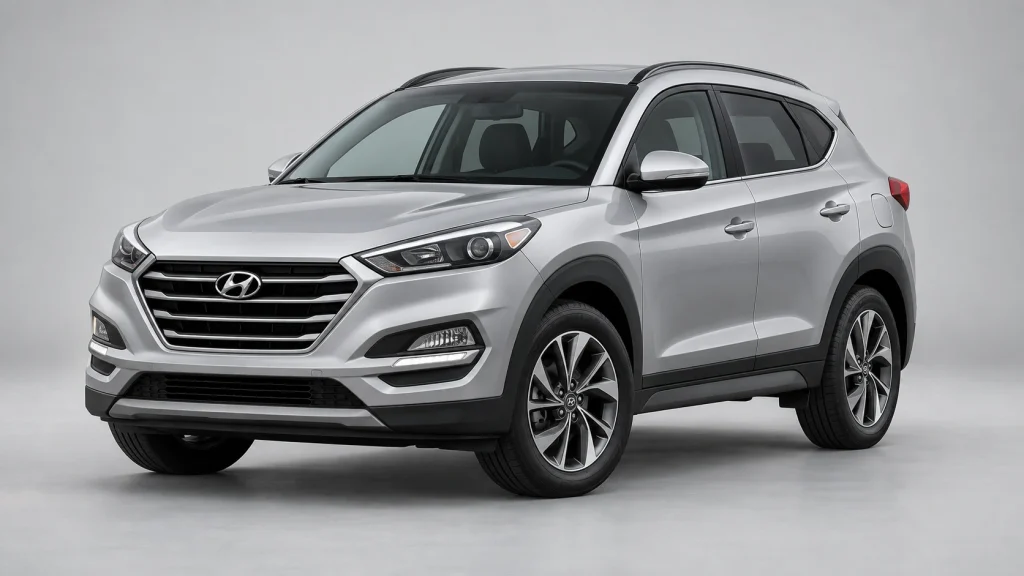
The Hyundai Tucson hub gathers everything CarFaultIQ tracks for this model: common problems by year, the strongest and riskiest years to buy, and what a used-car inspection should focus on.
Watch two zones: Theta II-era engine concerns (2011–2015, check official campaigns by VIN) and dual-clutch hesitation complaints on 2016–2018 1.6T models.
Start with the common-problems page below, then cross-check any candidate car against the symptom and OBD-code pages it links to.
Evidence-backed model intelligence
Hyundai Tucson diagnostic overview
Structured coverage spans 2005-2026. Use the exact model year and symptoms when narrowing a fault.
Vehicle coverage
- Powertrain evidence: Electricity, Hydrogen and Regular Gasoline
- Electrification: Electric, Hybrid and Plug-in Hybrid
- Drivetrain coverage: 4WD, 4WD/AWD, 4X4, AWD and FWD
Start with the evidence you have
A symptom and an OBD code are separate evidence channels. Use either one; do not assume a stored code proves a particular repair.
Official evidence for this model
Coverage below spans the explicitly mapped model years. Records do not apply to every model year or configuration.
US safety recalls
36 distinct official identifiers · US
Campaigns matched to recorded model years. Only an official VIN check can confirm whether an individual vehicle is affected.
- 26V400000 — model years 2025, 2026
Hyundai Motor America (Hyundai) is recalling certain 2025-2026 Tucson, Tucson Hybrid, Tucson Plug-In Hybrid Electric (PHEV) vehicles. Due to a software error, the instrument panel display may fail. As such, these vehicles fail to comply with the requirements of Federal Motor Vehicle Safety Standard (FMVSS)…
- 26V316000 — model years 2025, 2026
Hyundai Motor America (Hyundai) is recalling certain 2025-2026 Santa Cruz, Tucson, Tucson Hybrid, and Tucson Plug-In Hybrid Electric (PHEV) vehicles. Software in the front cameras may cause the forward collision avoidance system to activate prematurely and unexpectedly apply the brakes.
- 26V254000 — model years 2026
Hyundai Motor America (Hyundai) is recalling certain 2025 Elantra N, 2026 Tucson, Tucson Hybrid, Tucson Plug-In Hybrid Electric (PHEV), and Elantra vehicles. The B-pillar impact sensors may have been misassembled, which can delay air bag deployment.
Manufacturer communications / TSBs
516 distinct official identifiers · US
Manufacturer service communications are not safety recalls and do not prove that every vehicle has the described condition.
- 11036205 — model years 2022, 2023, 2024, 2025
Certain 2022 – 2025 model year Santa Cruz and 2022 – 2025 model year Tucson vehicles may have front wipers that do not return to the designated park position due to a loose wiper motor crank arm nut. At Hyundai, we are committed to providing…
- 11035138 — model years 2022, 2023, 2024, 2025
Some Tucson (NX4A and NX4M) and Santa Cruz (NXT) vehicles may have front wipers that do not return to the designated park position due to a loose wiper motor crank arm nut. Hyundai is extending the warranty coverage for the wiper motor crank arm nut…
- 11035136 — model years 2022, 2023, 2024, 2025
Some Tucson (NX4A and NX4M) and Santa Cruz (NXT) vehicles may have front wipers that do not return to the designated park position due to a loose wiper motor crank arm nut. Hyundai is extending the warranty coverage for the wiper motor crank arm nut…
US defect investigations
5 distinct official identifiers · US
An investigation records a regulator review of a suspected defect. It is not automatically a finding or a recall.
- AQ23002 — model years 2010, 2011, 2012, 2013, 2014, 2015, 2019, 2020, 2021
The Office of Defects Investigation (ODI) has received eight Hyundai Motor America (Hyundai) and eight Kia America, Inc. (Kia) Part 573 Recall Reports between 2016 and 2023. The combined 16 safety recalls all involve the antilock braking system (ABS) modules or Hydraulic Electronic Control Units…
- DP22005 — model years 2022
NHTSA received a petition on or about July 18, 2022, requesting that Federal Motor Vehicle Safety Standard (FMVSS) 141 be applied to all electric and hybrid vehicles operating in the United States. The petition can be reviewed at NHTSA.gov under ODI Number 11486072. FMVSS 141…
- DP22003 — model years 2010, 2011, 2012, 2013, 2014, 2015, 2016, 2017, 2018, 2019, 2022
The National Highway Traffic Safety Administration (NHTSA) received a letter dated July 13, 2022, petitioning the Agency to initiate a safety defect investigation into loss of motive power allegations attributed to oil drain pan assembly failures on certain Hyundai Motor America, Inc. and Kia America,…
Canadian recalls
40 distinct official identifiers · CA
Canadian-market records remain separate from US campaigns. Confirm applicability with Transport Canada and the manufacturer.
- 2026308 — model years 2025, 2026
Issue: On certain vehicles, a software problem could cause the instrument panel cluster to reboot while driving. As a result, you may not be able to see certain information about the vehicle, including the speedometer, fuel gauge, warning lights and malfunction tell-tales. Note: This recall…
- 2026238 — model years 2025, 2026
Multiple source assertions are retained for this identifier. Consult the official record for configuration-specific details.
- 2026199 — model years 2026
Issue: On certain vehicles, the side-impact sensors may not have been manufactured properly. As a result, the driver-front and passenger-front airbags may not work properly in a crash. Note: This recall also affects hybrid (HEV) and plug-in hybrid (PHEV) models. Safety Risk: Airbags that don't…
US owner complaint reports
6,241 distinct reports · US
Distinct ODI complaint identifiers, deduplicated across component and product rows. Reports are allegations, not confirmed defects, failure rates or reliability scores.
- ENGINE: 2,357 reports
- POWER TRAIN: 1,179 reports
- UNKNOWN OR OTHER: 809 reports
A report can name several components. Do not add component totals together.
Evidence is served from a locally stored official-source snapshot. No external API is called to render this page. These records do not replace inspection or diagnosis. Contains information licensed under the Open Government Licence – Canada.