Updated Last reviewed September 15, 2026By CarFaultIQ Editorial Team
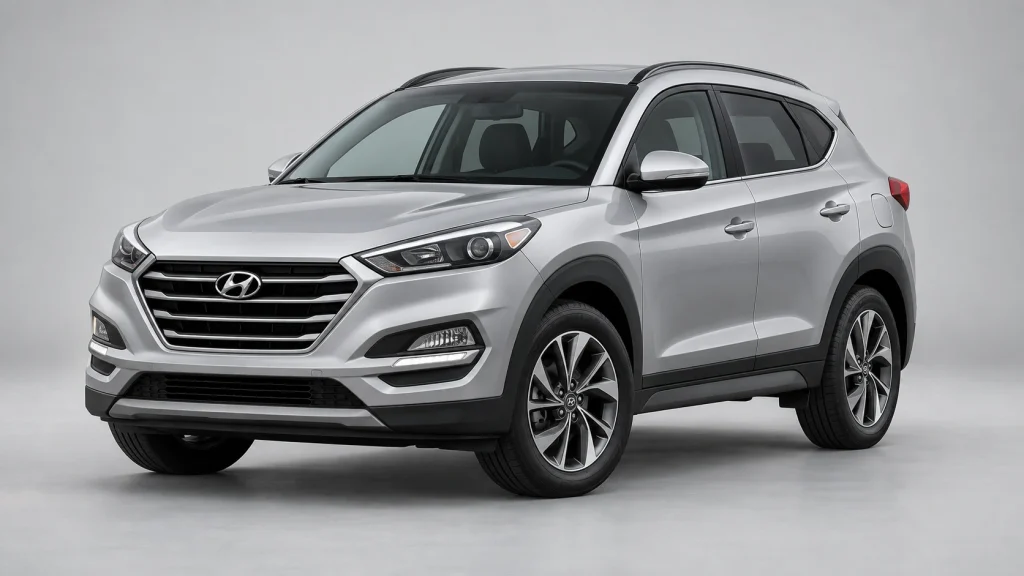
Representative editorial illustration; not an exact year or trim photograph.
Verify with official recall databases, service records, a mechanic inspection, and local market data before relying on this summary.
Short answer
A used Hyundai Tucson is a purchase that demands verification first: target 2019+, approach 2011–2015 with the inspection list below, and verify recall status by VIN before money moves.
Buyer riskHigh
Key takeaways
Buyer risk level: High.
Target years: 2019+; 2016–2018 with verified campaign history and acceptable DCT behavior.
Caution years: 2011–2015.
The inspection checklist below is the page — take it to the viewing.
Strong years
2019+ — post-concern-era cars with stronger records
2016–2018 with verified campaign history and acceptable DCT behavior
Risk years
2011–2015 — Theta II-era engine concern years
The records behind these years: Hyundai Tucson
For each group of years named above, the records CarFaultIQ holds for the same system, with three neighbouring years on each side for comparison. Named years are highlighted; open a year for its full evidence.
Years named as risk years: 2011–2015 — Owner complaints classified under engine
Record counts are not adjusted for how many vehicles were sold in each year, so a taller bar is not proof that a year is worse. The year guidance above is CarFaultIQ editorial; the bars are the records.
This page is the pre-purchase briefing for a used Hyundai Tucson: the years that earn their reputation, the faults that cost real money, and the inspection list that protects you.
Everything here describes documented report patterns, hedged deliberately — no complaint counts, failure rates or repair prices are claimed. The structured sections below are designed to be taken to a viewing.
Recalls and service campaigns have applied to some years. Always run the exact VIN through the official recall database (NHTSA in the US, DVSA in the UK, Transport Canada, or the Australian vehicle recalls database) before relying on any summary.
Common expensive faults
Theta II-era engine failure reports (2011–2015) — the defining risk; campaigns applied to some VINs
The 1.6T's dual-clutch (2016–2018) hesitates at crawl speeds by design and by reported pattern; verify software updates by VIN and decide on a test drive whether the behavior is acceptable to you.
Engine concerns
Engine verification is the heart of buying this era of Tucson: knock, consumption and campaign status by VIN decide the purchase. Any bottom-end noise ends the viewing.
Electrical concerns
No dominant electrical pattern; standard accessory checks apply.
Safety & recall notes
Recalls and service campaigns have applied to some years. Always run the exact VIN through the official recall database (NHTSA in the US, DVSA in the UK, Transport Canada, or the Australian vehicle recalls database) before relying on any summary.
Buyer inspection checklist
Run the VIN through official campaign lookups before viewing
Cold-start and listen for bottom-end knock — disqualifying if present
Check oil level and ask about consumption directly
Test the DCT (2016–2018) in stop-and-go and on a hill start
Get campaign/extended-warranty status in writing
Checklist copied.
Red flags
Any knock or tick from the bottom end
Seller cannot produce campaign documentation on a 2011–2015 car
Oil level low at viewing with no records
Safer alternatives
Honda CR-V of comparable years — fewer engine-era concerns
Toyota RAV4 — the segment's conservative pick
Mazda CX-5 — strong reports, engaging trade-offs
Frequently asked questions
What should I check first on a used Tucson?
Run the VIN through official campaign lookups before viewing — it screens for the model's defining risk before anything else.
Which used Tucson years are safest?
2019+; 2016–2018 with verified campaign history and acceptable DCT behavior carry the fewest documented repeat patterns.
Should recalls scare me off?
No — completed recalls are fixed cars. Unverified recall status is the risk, which is why the VIN lookup is non-negotiable.
The Hyundai Tucson is commonly reported to experience a dual-clutch (DCT) clutch-actuator concern, often associated with the 2016–2018 model years. It can…
The Hyundai Tucson is commonly reported to experience a knock-sensor / engine-protection warning, often associated with the 2016–2018 model years. It can…