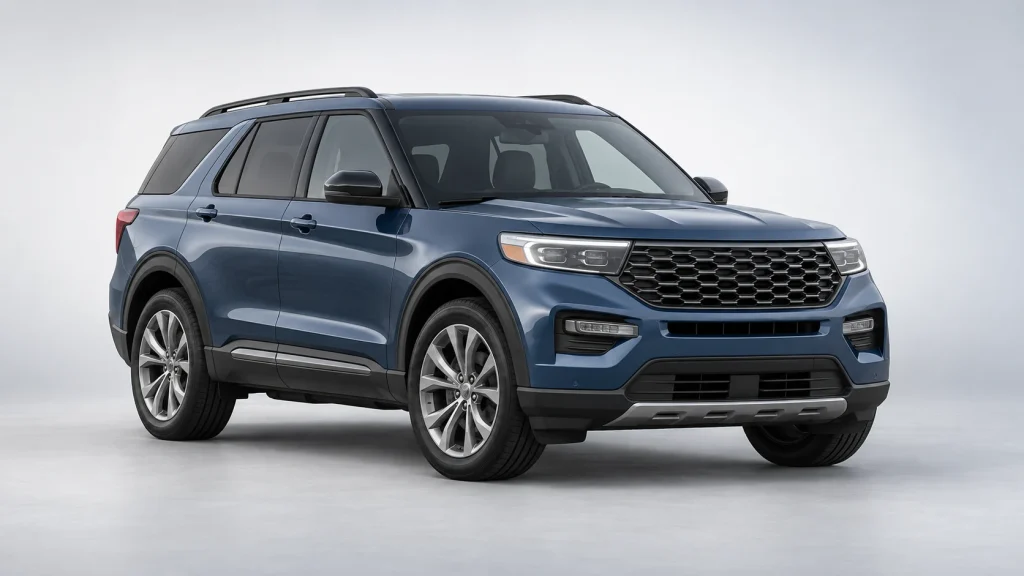
Owner complaints for this model most often concern:
Powertrain (transmission & drivetrain)10,452 (13.6%)Official recall records for this system: 33, covering model years 1999–2025.
Body & structure9,882 (12.9%)Official recall records for this system: 27, covering model years 1995–2026.
Steering8,178 (10.6%)Official recall records for this system: 12, covering model years 1995–2023.
Where a mileage was given (32,342 reports), it averaged 75,925 miles.
These are counts of records held, not a failure rate: no vehicles-in-service figure exists in this data, so no reliability score can be derived from it.
Before you buy a used Ford Explorer: what to check
Give these systems extra attention Model-specific · evidence-led
These systems are listed first because owner complaints for the Ford Explorer most often concern them. That is where records concentrate — it is not a finding that any individual car has a fault.
Powertrain (transmission & drivetrain)10,452 complaints classified here (13.6% of classifications)
Check for delayed or harsh shifts, slipping or shudder, both cold and when warm.
Ask when the transmission fluid was last serviced, and for any transmission repair records.
Body & structure9,882 complaints classified here (12.9% of classifications)
Look for corrosion, uneven gaps and signs of structural repair; have it checked on a lift.
Steering8,178 complaints classified here (10.6% of classifications)
Check the steering feels consistent, with no knocks, stiffness or wandering on a straight road.
Turn lock to lock while stationary and listen for groaning or clunks.
Tires & wheels7,010 complaints classified here (9.1% of classifications)
Check tread depth and even wear on all four tires, and the tire date codes.
Check the tire-pressure warning lamp goes out after starting.
Good practice for any used car Generic
Documents & seller questions
Run the VIN through the official recall lookup (NHTSA in the US, Transport Canada in Canada) and ask for proof that open recalls were completed.
Ask for service records, and when the transmission fluid, coolant and brake fluid were last changed.
Ask whether the car has been in a collision or a flood, and whether any warning light has been on recently.
Before starting
Arrange to see it with the engine cold — ask the seller not to warm it up first.
Look for uneven panel gaps, mismatched paint and fresh underseal, which can indicate repair work.
Cold start
Watch every warning lamp light up with the ignition on, then go out once the engine runs.
Listen for rattles, knocks or a rough idle in the first minute, and look for smoke from the exhaust.
Engine bay
Check the oil and coolant levels and condition; note any milky oil or oily coolant.
Look for fresh leaks, wet hoses and signs of recent cleaning that could hide leaks.
Test drive
Drive at town and highway speeds; note hesitation, vibration, pulling or unusual noise.
Check that every gear engages smoothly, including reverse, from cold and when warm.
Underbody & leaks
After the drive, look under the car for fresh drips.
Have a mechanic check the underside for corrosion, damaged components and leaks on a lift.
An inspection checklist, not a diagnosis. A pre-purchase inspection by an independent mechanic is the reliable way to assess a specific car.
Short answer
If you are checking a used Ford Explorer, start here. This hub collects midsize SUV buyer checks, future common-problem pages, OBD clues, and year-window risk notes as they are reviewed.
Key takeaways
This Ford Explorer page is a vehicle hub, not a final reliability verdict. Verify open recalls by VIN, scan for stored codes before buying, and use sourced fault/year pages when they are available.
CarFaultIQ holds structured coverage for the Ford Explorer spanning 5 generations from 1995 through 2026, built on engines from 2 to 5-litre, 4, 6 and 8-cylinder configurations on gasoline and regular gasoline, with hybrid variants. No Fault, recall, or complaint record is yet attached to the Explorer in CarFaultIQ's system, and none of its generations has a dedicated coverage page so far.
If you are checking a used Ford Explorer, this hub is the starting point. It is built to gather the practical questions a buyer or owner actually has: what usually goes wrong, which year windows deserve caution, what warning signs matter, and what to check before money changes hands.
The Ford Explorer is tracked here as a midsize SUV coverage hub. This page is a researched coverage page, not a final reliability verdict. Specific defect claims should come from sourced child pages, not guesswork.
Before buying or ignoring symptoms, verify open recalls by VIN, scan for stored OBD codes, check service history, and use any linked CarFaultIQ fault or symptom pages to decide the next practical step.
Evidence-backed model intelligence
Ford Explorer diagnostic overview
Structured coverage spans 1995-2026. Use the exact model year and symptoms when narrowing a fault.
Vehicle coverage
Powertrain evidence: Electricity, Ethanol (E85), Gasoline and Regular Gasoline
Coverage below spans the explicitly mapped model years. Records do not apply to every model year or configuration.
US safety recalls
144 distinct official identifiers · US
Campaigns matched to recorded model years. Only an official VIN check can confirm whether an individual vehicle is affected.
26V548000 — model years 2026
Ford Motor Company (Ford) is recalling certain 2026 Explorer, Bronco, Bronco Sport, Mustang, and Ranger vehicles. The engine piston domes may have been manufactured incorrectly, which can result in piston dome failure and lead to a loss of drive power.
26V532000 — model years 2026
Ford Motor Company (Ford) is recalling certain 2026 Explorer vehicles equipped with a 2.3L engine. The engine connecting rod bearings may seize, which can result in engine failure.
26V470000 — model years 2025, 2026
Ford Motor Company (Ford) is recalling certain 2025-2027 Explorer and Lincoln Aviator vehicles. An unoccupied driver's seat may recline unintentionally during certain scenarios, such as remote unlock or remote start.
Manufacturer service communications are not safety recalls and do not prove that every vehicle has the described condition.
11036103 — model years 2020, 2021, 2022, 2023, 2024, 2025
Some 2020-2025 Explorer vehicles equipped with a power roof opening panel may exhibit a sunshield with localized bunching or binding/inoperative. This may be due to a broken or missing sunshield fabric retainer/clip. A revised sunshield clip (LJ6Z-5452118-B) is now available to address this condition. It…
11036107 — model years 2026
Some 2025-2026 Aviator/Explorer/Expedition/F-150/Mustang Mach-E/Navigator vehicles may exhibit the hands-free BlueCruise feature intermittently/consistently unavailable when BlueCruise is active and when traveling in a "Blue Zone". Speed sign recognition may also be inaccurate. If there are no active relevant diagnostic trouble codes (DTC) present and the issue…
11035581 — model years 2024, 2025, 2026
Some 2024-2026 Explorer vehicles built on or before 27-Feb-2026 and equipped with the panoramic glass roof may exhibit an uneven gap at the front edge of the roof opening panel shield when fully closed. The gap is an appearance issue only, but may allow outside…
An investigation records a regulator review of a suspected defect. It is not automatically a finding or a recall.
DP25001 — model years 2020
The Office of Defects Investigation (ODI) received a petition on August 22, 2025, requesting a defect investigation into an alleged defect of the “underbody shields” on model year (MY) 2020 Ford Explorer vehicles. The petition alleges premature degradation and detachment of the plastic underbody shields,…
EA23002 — model years 2021, 2022
On July 22, 2022, the Office of Defects Investigation (ODI) granted a Defect Petition (DP22001) and opened a Preliminary Evaluation (PE22007) to investigate allegations of loss of motive power in model year (MY) 2021 Ford Bronco vehicles equipped with 2.7L EcoBoost engines. Complainants were reporting…
RQ23002 — model years 2020, 2021, 2022
On July 17, 2023, the Office of Defect Investigation (ODI) opened this Recall Query (RQ) after receiving 2 consumer complaints alleging loss of vehicle forward power and/or loss of transmission torque of the rear wheels in model year (MY) 2020-2022 Ford Explorer vehicles (subject vehicles).…
Canadian-market records remain separate from US campaigns. Confirm applicability with Transport Canada and the manufacturer.
2026411 — model years 2026
Multiple source assertions are retained for this identifier. Consult the official record for configuration-specific details.
2026341 — model years 2016, 2017, 2018, 2019
Issue: On certain vehicles, the repairs completed by a Ford dealer during customer satisfaction program 20N11 may not be effective. As a result, a second repair is required. On certain vehicles, the roof rail covers could become loose and detach while driving. Note: This recall…
2026339 — model years 2020, 2021, 2022, 2023, 2024, 2025, 2026
Issue: On certain vehicles the recall repairs completed by a Ford dealer during recall 25S67 (Transport Canada recall no. 2025-328) may not be effective. As a result, a second repair is required. On certain vehicles, the trim for the seat fold switch on the second-row…
Distinct ODI complaint identifiers, deduplicated across component and product rows. Reports are allegations, not confirmed defects, failure rates or reliability scores.
STEERING: 3,660 reports
UNKNOWN OR OTHER: 3,043 reports
POWER TRAIN: 2,361 reports
A report can name several components. Do not add component totals together.
Evidence is served from a locally stored official-source snapshot. No external API is called to render this page. These records do not replace inspection or diagnosis. Contains information licensed under the Open Government Licence – Canada.
Used-car checks
No structured used-car checks are verified on this model hub yet.
Recall/safety notes
No hand-written safety notes have been added to this hub. Official recall, bulletin and investigation records held for this vehicle are listed under documented evidence on this page — the absence of a note here does not mean no records exist. Always confirm by VIN.
That reflects what CarFaultIQ has documented for the Explorer so far, not a claim that it has no issues, and evidence coverage is added model by model as it is verified. Until Explorer-specific evidence is added, CarFaultIQ's OBD code and symptom lookup tools cover this vehicle the same way they cover any car, and a VIN recall check is the reliable step for a used example.