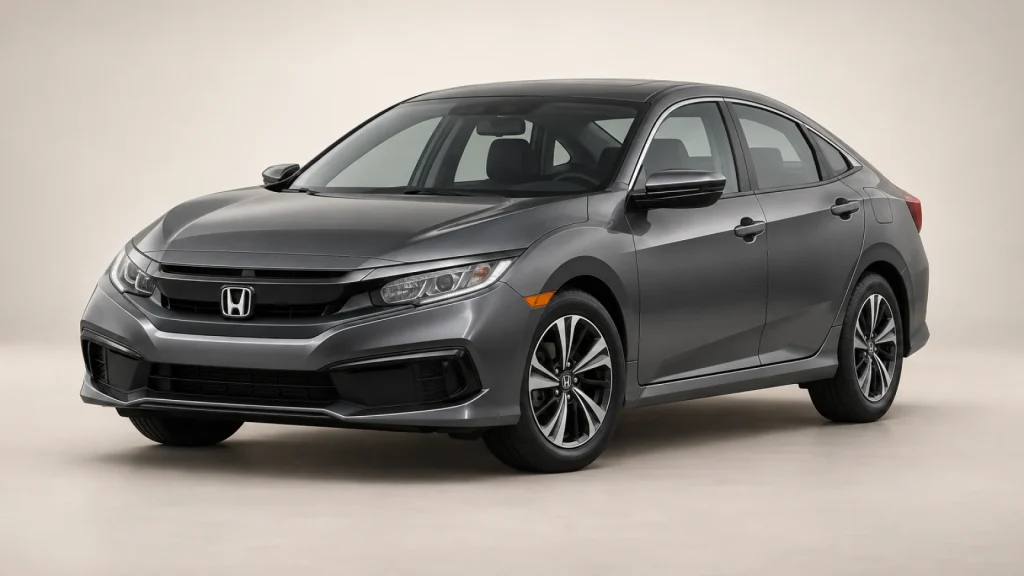
Showing coverage that applies to the Honda Civic across 2016–2021.
The 2016–2021 Civic is the tenth-generation car in CarFaultIQ's coverage. The imported vehicle records for these model years show 1.5- and 2.0-litre four-cylinder gasoline configurations, on both regular and premium fuel. What follows gathers the issue pages, recall campaigns and complaint categories that can be tied to this specific year range rather than to the Civic as a whole.
What was offered in these years
- Engine sizes: 1.5L, 2L
- Cylinder counts: 4
- Powertrain types: gasoline
- Fuel types: premium gasoline, regular gasoline
Displacements and powertrain types come from the imported vehicle records for these model years. A specific engine code cannot be established from displacement alone, so no engine-specific claim is made here.
Documented problems for these years
Six documented pages apply to these years, and most of them sit in the earlier part of the generation rather than across all of it. Air conditioning appears twice — a condenser leak recorded for 2016–2020 and a compressor failure recorded for 2016–2018. The powertrain records are also early: CVT shudder for 2016–2020 and 1.5T oil dilution reports for 2016–2018, alongside an emissions-message page covering 2016–2018. Only the sun-visor record spans the full 2016–2021 range. A 2021 car therefore falls inside far fewer of these records than a 2016 one.
- Honda Civic A/C Condenser Leak 2016–2020
- Honda Civic CVT Shudder 2016–2020
- Honda Civic Loose Sun Visor 2016–2021
- Honda Civic “Emissions System Problem” Message 2016–2018
- Honda Civic: Air Conditioning Compressor Failure (2016–2018) 2016–2018
- Honda Civic: 1.5T Oil Dilution Reports (2016–2018) 2016–2018
Recall campaigns covering these years
Eight campaigns reach into this window, across five systems: air bags, gasoline fuel delivery, hydraulic service brakes, electric power steering, and owner and service documentation. Only two apply to the full range — an occupant-classification sensor campaign and a fuel-pump campaign. The others are narrower: a brake master-cylinder campaign and a second airbag-sensor campaign affect 2020–2021, two further fuel-pump campaigns affect 2018–2020, and the power-steering and service-manual campaigns affect 2017–2018.
- 26V332000 — AIR BAGS:SENSOR:OCCUPANT CLASSIFICATION:FRONT PASSENGER affects 2016–2021
- 24V064000 — AIR BAGS:SENSOR:OCCUPANT CLASSIFICATION:FRONT PASSENGER applies to 2020–2021 within this 2016–2021 window
- 23V858000 — FUEL SYSTEM, GASOLINE:DELIVERY:FUEL PUMP affects 2016–2021
- 23V458000 — SERVICE BRAKES, HYDRAULIC:FOUNDATION COMPONENTS:MASTER CYLINDER applies to 2020–2021 within this 2016–2021 window
- 21V215000 — FUEL SYSTEM, GASOLINE:DELIVERY:FUEL PUMP applies to 2019–2020 within this 2016–2021 window
- 20V314000 — FUEL SYSTEM, GASOLINE:DELIVERY:FUEL PUMP applies to 2018–2019 within this 2016–2021 window
- 18V817000 — EQUIPMENT:OTHER:OWNERS/SERVICE/OTHER MANUAL applies to 2017–2018 within this 2016–2021 window
- 18V663000 — STEERING:ELECTRIC POWER ASSIST SYSTEM applies to 2017–2018 within this 2016–2021 window
A model and year match does not prove a specific vehicle is affected. Check the VIN against the official recall database. Check a VIN at NHTSA
Reported complaint patterns
Six categories recur in aggregated owner reports for these years: air bags, steering, power train, engine, visibility, and an unclassified group. These are reports owners filed, not confirmed failures. A category appearing here tells you where attention has clustered; it does not establish how often a part fails, or that a defect exists in any particular car.
- Air Bags reported across 2016–2021
- Steering reported across 2016–2021
- Power Train reported across 2016–2021
- Unknown Or Other reported across 2016–2021
- Engine reported across 2016–2021
- Visibility reported across 2016–2021
These are categories that recur in aggregated owner reports for these years. They are evidence signals, not failure rates or proof of a defect.
Buying and inspection guidance
- Best & Worst Honda Civic Years model-wide
- Honda Civic Common Problems model-wide
- Honda Civic Recall and Complaint Evidence model-wide
- Used Honda Civic Buying and Inspection Guide model-wide