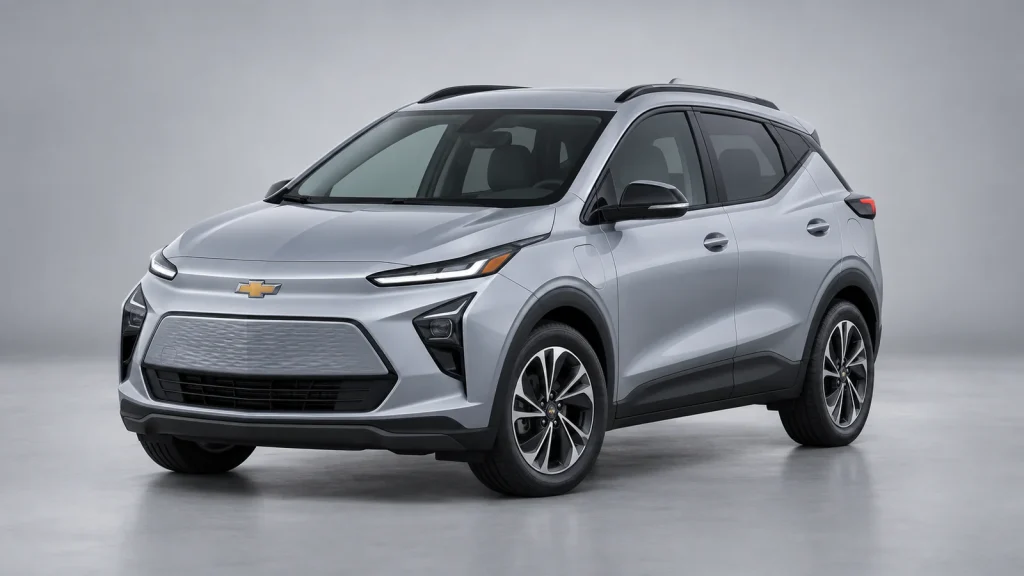
Chevrolet Bolt EUV coverage at CarFaultIQ spans 2022-2023. This canonical model hub combines structured year and configuration data with cautious evidence context, inspection priorities, and diagnostic navigation; individual trims and model years remain selectable data, not separate pages.
Chevrolet Bolt EUV coverage at a glance
- Supported years: 2022-2023 across 2 documented model years.
- Market scope: United States.
- Structured depth: 2 canonical model-year records and 4 source-backed configuration variants.
- Page tier: Tier B — structured factual coverage with explicit evidence limitations.
Powertrain, fuel, and drivetrain coverage
The structured snapshot records body styles as not consistently specified, fuel types as Electricity, and electrification as Electric. Drivetrain labels include FWD; transmission labels include Automatic (A1)|Automatic 1-speed|Automatic (variable gear ratios)|Automatic 1-speed. Availability varies by year and market, so use the selected-year module rather than treating this list as one configuration.
Evidence state
This is a structured factual model hub. No local recall or complaint evidence is safely matched at model level for public claims, so this page does not infer common problems, reliability, best or worst years, absence of recalls, absence of complaints, failure rates, or repair costs.
What to inspect first
- Confirm the VIN, exact model year, market, trim, and drivetrain before applying any evidence or service information.
- Complete a cold start, warning-light bulb check, road test, brake check, tire inspection, fluid-leak inspection, and diagnostic-code scan.
- Check steering tracking, suspension noise, brake feel, cabin electronics, and evidence of unresolved fluid leaks.
- For an EV, review charge history and battery-health information; test AC and DC charging and inspect the high-voltage system only through qualified service procedures.
Diagnostic paths
These references are relevant starting points, not claims that a condition is common on this model.
- No-start diagnostic checks
- Acceleration hesitation checks
- Check-engine-light guidance
- P0300 random-misfire reference
- P0420 catalyst-efficiency reference
- Pre-purchase inspection guide
- How to read OBD codes
Source limits and review method
Vehicle identity, year, market, body, powertrain, and configuration fields come from the CarFaultIQ v3.1 structured dataset and its traceable source-evidence records (DOE/EPA FuelEconomy.gov). Recall and complaint data, where present, come from local NHTSA-derived snapshots. Recall applicability remains VIN-specific; aggregated complaint signals are owner reports and do not prove causation or population frequency.
Questions about Chevrolet Bolt EUV coverage
Frequently asked questions
Does this page rank the best or worst Chevrolet Bolt EUV years?
No. It reports structured coverage and evidence limits without rating reliability, safety, repair cost, or model years.
Does a recall match mean every Chevrolet Bolt EUV is affected?
No. Applicability depends on the VIN, build information, equipment, market, and remedy status.
Are complaint signals confirmed defects?
No. They are aggregated owner-reported signals and do not prove causation or population frequency.
Official evidence for this model
Coverage below spans the explicitly mapped model years. Records do not apply to every model year or configuration.
US safety recalls
4 distinct official identifiers · US
Campaigns matched to recorded model years. Only an official VIN check can confirm whether an individual vehicle is affected.
- 24V812000 — model years 2022
General Motors, LLC (GM) is recalling certain 2020-2022 Chevrolet Bolt EV and 2022 Bolt EUV vehicles previously repaired under Recall 21V-650. The installation of advanced diagnostic software may have failed. As such, the high voltage battery could catch fire when charged to full or nearly…
- 24V481000 — model years 2022
General Motors, LLC (GM) is recalling certain 2020-2022 Chevrolet Bolt EV and 2022 Chevrolet Bolt EUV vehicles that were previously remedied under recall number 21V-650. The advanced diagnostic software may have been incorrectly installed and fail to detect defective battery modules, possibly resulting in a…
- 21V650000 — model years 2022
General Motors, LLC (GM) is recalling certain 2020-2022 Chevrolet Bolt EV and 2022 Chevrolet Bolt EUV vehicles. The high voltage battery could catch fire when charged to full or nearly full capacity.
Manufacturer communications / TSBs
492 distinct official identifiers · US
Manufacturer service communications are not safety recalls and do not prove that every vehicle has the described condition.
- 11036392 — model years 2022, 2023
This Preliminary information communicates to dealer to perform a MEC reset for wireless projection issues
- 11036284 — model years 2022, 2023
Certain vehicles may have a condition where a false diagnostic trouble code (DTC) is set. Dealers are to reprogram the Hybrid Powertrain Control Module 2.
- 11035340 — model years 2022, 2023
PI to help diagnose A/C concern
US defect investigations
1 distinct official identifiers · US
An investigation records a regulator review of a suspected defect. It is not automatically a finding or a recall.
- DP22005 — model years 2022
NHTSA received a petition on or about July 18, 2022, requesting that Federal Motor Vehicle Safety Standard (FMVSS) 141 be applied to all electric and hybrid vehicles operating in the United States. The petition can be reviewed at NHTSA.gov under ODI Number 11486072. FMVSS 141…
Canadian recalls
2 distinct official identifiers · CA
Canadian-market records remain separate from US campaigns. Confirm applicability with Transport Canada and the manufacturer.
- 2023486 — model years 2022, 2023
Issue: The portable charging cord included with certain vehicles could have incorrect software. As a result, if the ground connection is lost during charging, the portable charging cord may not stop charging the vehicle. Safety Risk: A charging cord that isn't grounded could create a…
- 2021524 — model years 2022
Multiple source assertions are retained for this identifier. Consult the official record for configuration-specific details.
US owner complaint reports
142 distinct reports · US
Distinct ODI complaint identifiers, deduplicated across component and product rows. Reports are allegations, not confirmed defects, failure rates or reliability scores.
- STEERING: 32 reports
- ELECTRICAL SYSTEM: 27 reports
- FORWARD COLLISION AVOIDANCE: AUTOMATIC EMERGENCY BRAKING: 24 reports
A report can name several components. Do not add component totals together.
Evidence is served from a locally stored official-source snapshot. No external API is called to render this page. These records do not replace inspection or diagnosis. Contains information licensed under the Open Government Licence – Canada.