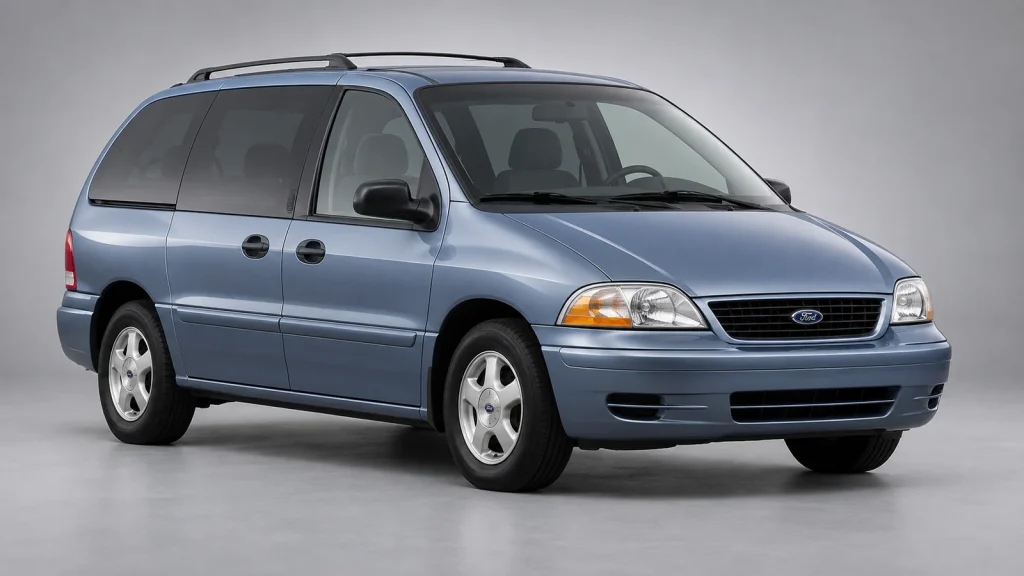
The Ford Windstar hub is a CarFaultIQ evidence page for a family-vehicle model where inspection should account for braking, sliding-door or cargo hardware, seating, and age-related wear. It connects the imported vehicle-year database with local recall and owner-complaint snapshots, then points toward relevant diagnostic references without making unsupported reliability or repair-cost claims.
Supported years and market coverage
Structured coverage currently spans 1995-2003 with 9 canonical model-year records and 52 structured variants. Market coverage in the imported data includes United States and Canada.
Powertrain and configuration overview
Imported source records list fuel or energy labels including Regular Gasoline. Electrification labels include Gasoline|X. Drivetrain and trim-level detail remains in the structured selector rather than separate year or variant posts.
Selected-year evidence module
Use the structured year selector on this page to compare imported variants and local evidence status by model year. The selector is intentionally dynamic; CarFaultIQ does not create one page per model year or trim.
Relevant diagnostic references
- No-start with lights working – contextual CarFaultIQ reference, not a model-specific incidence claim.
- Jerking or hesitation under acceleration – contextual CarFaultIQ reference, not a model-specific incidence claim.
- Spongy brake pedal checks – contextual CarFaultIQ reference, not a model-specific incidence claim.
- Pulling to one side – contextual CarFaultIQ reference, not a model-specific incidence claim.
- P0300 misfire reference – contextual CarFaultIQ reference, not a model-specific incidence claim.
- P0420 catalyst-efficiency reference – contextual CarFaultIQ reference, not a model-specific incidence claim.
- P0171 lean-condition reference – contextual CarFaultIQ reference, not a model-specific incidence claim.
- Check engine light – contextual CarFaultIQ reference, not a model-specific incidence claim.
- Brake warning light – contextual CarFaultIQ reference, not a model-specific incidence claim.
- Tire-pressure warning light – contextual CarFaultIQ reference, not a model-specific incidence claim.
- Pre-purchase inspection preparation – contextual CarFaultIQ reference, not a model-specific incidence claim.
- Reading OBD codes before a mechanic visit – contextual CarFaultIQ reference, not a model-specific incidence claim.
Used-car inspection priorities
- Start with a cold vehicle when possible and note warning lights before clearing any codes.
- Road-test idle quality, acceleration, shift behavior, steering, braking, and operating temperature.
- Scan for stored codes and inspect for fluid leaks, tire wear, and underbody damage.
- Check VIN-specific recalls in official tools because the local snapshot may not contain every applicable campaign.
- Use a qualified pre-purchase inspection; this page is an evidence hub, not a substitute for diagnosis.
Evidence strength and limitations
This page separates recall evidence from complaint signals. Local evidence can be incomplete, and a missing matched row is not the same as proof that no recall, complaint, service bulletin, or owner concern exists.
Source notes
Structured vehicle coverage comes from the imported CarFaultIQ v3.1 vehicle database. Recall and complaint signals come from the local NHTSA harvester snapshots. Official recall applicability must be checked by VIN at NHTSA recalls.
Frequently asked questions
Does this page rank the best or worst Ford Windstar years?
No. It shows structured coverage and local evidence signals without ranking reliability, safety, repair cost, or best and worst years.
Does a matched recall mean every Ford Windstar is affected?
No. Recall campaign rows must be checked by VIN because applicability can depend on year, build date, equipment, market, and completed remedies.
Are complaint signals proof of a defect?
No. Complaint rows are owner-reported signals for editorial review and do not prove causation or frequency.
Structured vehicle data
These fields are read live from the imported v3.1 vehicle tables. They are configuration coverage, not reliability or safety conclusions.
- Fuel types: Regular Gasoline
- Electrification: Gasoline
- Drivetrain: FWD
- Total structured variants: 52
2003 structured configurations
| Market | Trim/source label | Fuel | Electrification | Drive | Transmission |
|---|---|---|---|---|---|
| Canada | Van | Regular Gasoline | Not specified | Not specified | Automatic 4-speed |
| Canada | Wagon | Regular Gasoline | Not specified | Not specified | Automatic 4-speed |
| US | FWD | Wagon|Wagon|FWD | Regular Gasoline | Gasoline | FWD | Automatic 4-speed |
Official evidence for this model
Coverage below spans the explicitly mapped model years. Records do not apply to every model year or configuration.
US safety recalls
38 distinct official identifiers · US
Campaigns matched to recorded model years. Only an official VIN check can confirm whether an individual vehicle is affected.
- 15V608000 — model years 1998, 1999, 2000, 2001, 2002, 2003
Ford Motor Company (Ford) is recalling certain model year 1998-2003 Windstar vehicles manufactured September 2, 1997, to July 3, 2003. The affected vehicles were previously remedied to safeguard against the rear axle cracking from corrosion, however, the remedy brackets may have been misinstalled. The incorrect…
- 12V194000 — model years 1999, 2000, 2001, 2002, 2003
FORD IS RECALLING CERTAIN MODEL YEAR 1999-2003 WINDSTAR VEHICLES ORIGINALLY SOLD IN OR CURRENTLY REGISTERED IN THE STATE OF VIRGINIA. CORROSION-RELATED FRACTURES OF THE FRONT LOWER CONTROL ARM REAR ATTACHING BRACKETS AND BODY MOUNT ATTACHMENTS MAY OCCUR.
- 12V193000 — model years 1998, 1999, 2000, 2001, 2002, 2003
FORD IS RECALLING CERTAIN MODEL YEAR 1998-2003 WINDSTAR VEHICLES MANUFACTURED FROM SEPTEMBER 1, 1997, THROUGH JULY 3, 2003, AND CURRENTLY REGISTERED OR ORIGINALLY SOLD IN VIRGINIA. OVER TIME, CORROSION CAN WEAKEN THE REAR AXLE MAKING IT SUSCEPTIBLE TO TORSIONAL STRESS. CORROSION AND STRESS CAN LEAD…
Manufacturer communications / TSBs
707 distinct official identifiers · US
Manufacturer service communications are not safety recalls and do not prove that every vehicle has the described condition.
- 10183766 — model years 1995, 1996, 1997, 1998, 1999, 2000, 2001, 2002, 2003
For 1999-2003 Windstar vehicles Safety Recall 11S16 has been issued for vehicles that are operated in high corrosion areas for an extended period, where a front subframe lower control arm (LCA) rear attaching flange or rear body mount could separate from the vehicle subframe. Separation…
- 10183771 — model years 1998, 1999, 2000, 2001, 2002, 2003
For 1998-2003 Windstar vehicles Safety Recall 10S13 has been issued for vehicles that are operated in high corrosion areas for an extended period, where the rear axle could potentially fracture. If the rear axle should completely fracture, vehicle handling may be affected which could increase…
- 10205035 — model years 1998, 1999, 2000, 2001, 2002, 2003
Safety recall 10S13 - Rear axle corrosion - requests for recall service action
US defect investigations
27 distinct official identifiers · US
An investigation records a regulator review of a suspected defect. It is not automatically a finding or a recall.
- EA10007 — model years 1999, 2000, 2001, 2002, 2003
In a January 26, 2011 Defect Information Report, Ford Motor Company (Ford) notified the National Highway Traffic Safety Administration (NHTSA) that it will conduct a safety recall to address corrosion related fractures in the front lower control arm rear attaching brackets and body mount attachments…
- DP10005 — model years 2003
On November 5, 2010, NHTSA received a Defect Petition from the owner of a MY 2003 Ford Windstar vehicle registered in the state of New York requesting that the scope of Recall 10V-385 be expanded to include additional MY 2003 vehicles experiencing the defect condition.The…
- PE10026 — model years 1999, 2000, 2001, 2002, 2003
The Office of Defects Investigation (ODI) has identified 346 complaints to ODI and Ford alleging fracture, cracking and or excessive corrosion of the front subframes in model year (MY) 1999 through 2003 Ford Windstar vehicles.Approximately 97 percent of these complaints (334) involve vehicles that have…
Canadian recalls
31 distinct official identifiers · CA
Canadian-market records remain separate from US campaigns. Confirm applicability with Transport Canada and the manufacturer.
- 2019420 — model years 1999, 2000, 2001, 2002, 2003
Multiple source assertions are retained for this identifier. Consult the official record for configuration-specific details.
- 2015437 — model years 1998, 1999, 2000, 2001, 2002, 2003
On certain vehicles that had rear axle reinforcement brackets installed as part of safety recall 2010-284, the brackets may not have been installed properly, which could limit the effectiveness of the recall service repair in addressing the safety defect. Safety recall 2010-284 was conducted to…
- 2011038 — model years 1999, 2000, 2001, 2002, 2003
On certain vehicles, the subframe may not have been properly e-coated during the manufacturing process. As a result, the subframe of vehicles originally sold, or currently registered, in areas of heavy road salt usage during winter months (Ontario, Quebec, New Brunswick, Nova Scotia, Prince Edward…
US owner complaint reports
14,083 distinct reports · US
Distinct ODI complaint identifiers, deduplicated across component and product rows. Reports are allegations, not confirmed defects, failure rates or reliability scores.
- ENGINE AND ENGINE COOLING:ENGINE: 1,630 reports
- POWER TRAIN:AUTOMATIC TRANSMISSION: 1,609 reports
- ELECTRICAL SYSTEM: 1,092 reports
A report can name several components. Do not add component totals together.
Evidence is served from a locally stored official-source snapshot. No external API is called to render this page. These records do not replace inspection or diagnosis. Contains information licensed under the Open Government Licence – Canada.