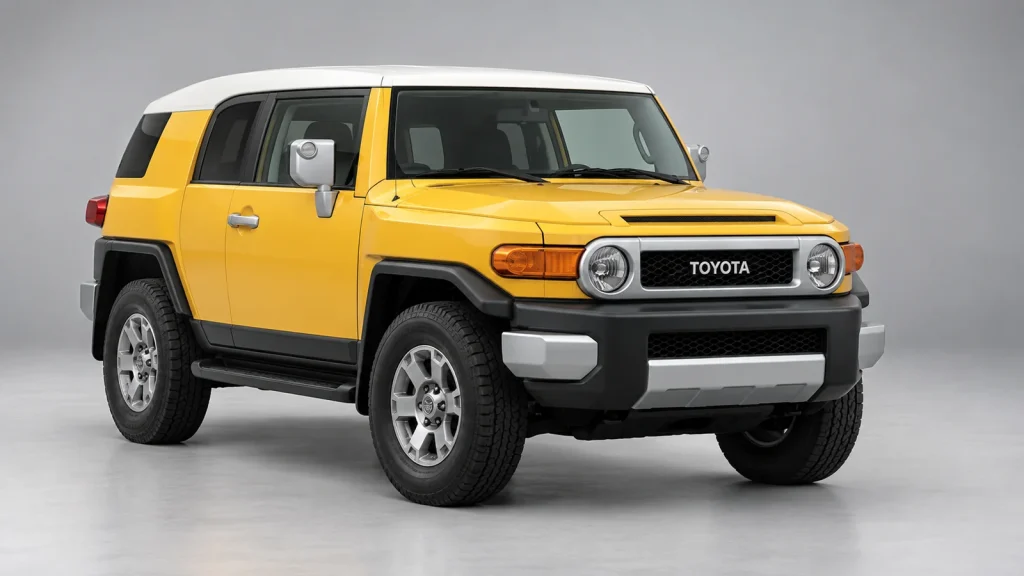
The Toyota FJ Cruiser hub is a CarFaultIQ evidence page for a consumer vehicle model represented in the structured dataset with year, market, powertrain, and configuration coverage. It connects the imported vehicle-year database with local recall and owner-complaint snapshots, then points toward relevant diagnostic references without making unsupported reliability or repair-cost claims.
Supported years and market coverage
Structured coverage currently spans 2007-2014 with 8 canonical model-year records and 40 structured variants. Market coverage in the imported data includes United States and Canada.
Powertrain and configuration overview
Imported source records list fuel or energy labels including Premium Gasoline|Regular Gasoline. Electrification labels include Gasoline|X|Gasoline|Z. Drivetrain and trim-level detail remains in the structured selector rather than separate year or variant posts.
Selected-year evidence module
Use the structured year selector on this page to compare imported variants and local evidence status by model year. The selector is intentionally dynamic; CarFaultIQ does not create one page per model year or trim.
Relevant diagnostic references
- No-start with lights working – contextual CarFaultIQ reference, not a model-specific incidence claim.
- Jerking or hesitation under acceleration – contextual CarFaultIQ reference, not a model-specific incidence claim.
- Spongy brake pedal checks – contextual CarFaultIQ reference, not a model-specific incidence claim.
- Pulling to one side – contextual CarFaultIQ reference, not a model-specific incidence claim.
- P0300 misfire reference – contextual CarFaultIQ reference, not a model-specific incidence claim.
- P0420 catalyst-efficiency reference – contextual CarFaultIQ reference, not a model-specific incidence claim.
- P0171 lean-condition reference – contextual CarFaultIQ reference, not a model-specific incidence claim.
- Check engine light – contextual CarFaultIQ reference, not a model-specific incidence claim.
- Brake warning light – contextual CarFaultIQ reference, not a model-specific incidence claim.
- Tire-pressure warning light – contextual CarFaultIQ reference, not a model-specific incidence claim.
- Pre-purchase inspection preparation – contextual CarFaultIQ reference, not a model-specific incidence claim.
- Reading OBD codes before a mechanic visit – contextual CarFaultIQ reference, not a model-specific incidence claim.
Used-car inspection priorities
- Start with a cold vehicle when possible and note warning lights before clearing any codes.
- Road-test idle quality, acceleration, shift behavior, steering, braking, and operating temperature.
- Scan for stored codes and inspect for fluid leaks, tire wear, and underbody damage.
- Check VIN-specific recalls in official tools because the local snapshot may not contain every applicable campaign.
- Use a qualified pre-purchase inspection; this page is an evidence hub, not a substitute for diagnosis.
Evidence strength and limitations
This page separates recall evidence from complaint signals. Local evidence can be incomplete, and a missing matched row is not the same as proof that no recall, complaint, service bulletin, or owner concern exists.
Source notes
Structured vehicle coverage comes from the imported CarFaultIQ v3.1 vehicle database. Recall and complaint signals come from the local NHTSA harvester snapshots. Official recall applicability must be checked by VIN at NHTSA recalls.
Frequently asked questions
Does this page rank the best or worst Toyota FJ Cruiser years?
No. It shows structured coverage and local evidence signals without ranking reliability, safety, repair cost, or best and worst years.
Does a matched recall mean every Toyota FJ Cruiser is affected?
No. Recall campaign rows must be checked by VIN because applicability can depend on year, build date, equipment, market, and completed remedies.
Are complaint signals proof of a defect?
No. Complaint rows are owner-reported signals for editorial review and do not prove causation or frequency.
Structured vehicle data
These fields are read live from the imported v3.1 vehicle tables. They are configuration coverage, not reliability or safety conclusions.
- Fuel types: Premium Gasoline, Regular Gasoline
- Electrification: Gasoline
- Drivetrain: 4WD/AWD, 4X4, RWD, 4WD, AWD
- Total structured variants: 40
2014 structured configurations
| Market | Trim/source label | Fuel | Electrification | Drive | Transmission |
|---|---|---|---|---|---|
| Canada | 4WD | Regular Gasoline | Not specified | 4WD | Manual 6-speed |
| Canada | 4WD | Regular Gasoline | Not specified | 4WD | Automatic 5-speed |
| US | 2WD | Regular Gasoline | Gasoline | RWD | Automatic 5-speed |
| US | 4WD | Regular Gasoline | Gasoline | 4WD | Automatic 5-speed |
| US | 4WD | Regular Gasoline | Gasoline | AWD | Manual 6-speed |
Official evidence for this model
Coverage below spans the explicitly mapped model years. Records do not apply to every model year or configuration.
US safety recalls
19 distinct official identifiers · US
Campaigns matched to recorded model years. Only an official VIN check can confirm whether an individual vehicle is affected.
- 20V012000 — model years 2014
Toyota Motor Engineering & Manufacturing (Toyota) recalled certain 2018-2019 4Runner, Highlander, Camry, Land Cruiser, Sequoia, Sienna, Tacoma and Tundra, and Lexus RC 300, RC 350, GS 350, GX 460, IS 300, LC 500, LS 500, LX 570, RX 350L, and 2019 Toyota Avalon and Corolla,…
- 16V396000 — model years 2007, 2008, 2009, 2010
Southeast Toyota Distributors, LLC (SET) is recalling certain 2005-2011 4Runner, Highlander, Sequoia, and Sienna, 2005-2010 Avalon and Tundra, 2006-2008 Camry Solara, 2006-2010 Highlander hybrid, 2006-2011 Rav4 and Tacoma, 2007-2010 FJ Cruiser, 2007-2011 Camry hybrid, 2009-2010 Venza, 2010-2012 Prius, 1988-1990 and 2005-2010 Camry, and 1989 and…
- 15V081000 — model years 2014
Toyota Motor Engineering & Manufacturing (Toyota) is recalling certain model year 2014 FJ Cruiser vehicles manufactured August 7, 2013, to August 20, 2013. In the affected vehicles, the intermediate steering shaft which connects the steering wheel and the steering gear box may have an inadequate…
Manufacturer communications / TSBs
259 distinct official identifiers · US
Manufacturer service communications are not safety recalls and do not prove that every vehicle has the described condition.
- 11028712 — model years 2007, 2008, 2009, 2010, 2011, 2012, 2013, 2014
Some 2005 – 2026 Toyota vehicles that have undergone water intrusion may exhibit a condition in which a musty odor is present. Follow the procedures in this bulletin to remediate the odor and address this condition. The purpose of this Service Bulletin is to provide…
- 11020657 — model years 2013, 2014
The air conditioning dye injection tool kit has been developed to aid in identifying the location of air conditioning refrigerant leaks. The procedures outlined in this Service Bulletin aid in locating, inspecting, and repairing refrigerant leaks.
- 11012744 — model years 2007, 2008, 2009, 2010, 2011, 2012, 2013, 2014
The condition known as acid rain is caused by airborne chemicals or particles in the atmosphere, which mix with rainwater, nighttime dew, or high humidity to form acidic compounds. If these contaminants settle and remain on a painted vehicle surface, especially the horizonal areas of…
Canadian recalls
8 distinct official identifiers · CA
Canadian-market records remain separate from US campaigns. Confirm applicability with Transport Canada and the manufacturer.
- 2021723 — model years 2007, 2008, 2010, 2012, 2013, 2014
Multiple source assertions are retained for this identifier. Consult the official record for configuration-specific details.
- 2020514 — model years 2014
Multiple source assertions are retained for this identifier. Consult the official record for configuration-specific details.
- 2020088 — model years 2014
Multiple source assertions are retained for this identifier. Consult the official record for configuration-specific details.
US owner complaint reports
905 distinct reports · US
Distinct ODI complaint identifiers, deduplicated across component and product rows. Reports are allegations, not confirmed defects, failure rates or reliability scores.
- STRUCTURE:BODY: 278 reports
- SUSPENSION: 120 reports
- UNKNOWN OR OTHER: 112 reports
A report can name several components. Do not add component totals together.
Evidence is served from a locally stored official-source snapshot. No external API is called to render this page. These records do not replace inspection or diagnosis. Contains information licensed under the Open Government Licence – Canada.