Updated Last reviewed September 15, 2026By CarFaultIQ Editorial Team
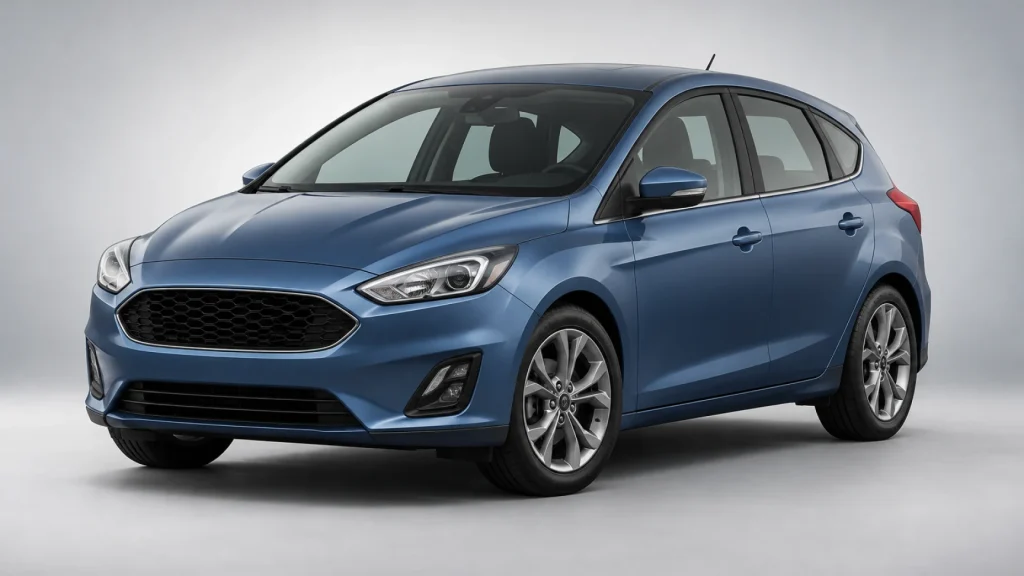
Representative editorial illustration of the Ford Focus.
Verify with official recall databases, service records, a mechanic inspection, and local market data before relying on this summary.
Short answer
A used Ford Focus is a purchase that demands verification first: target 2018 final-year cars with documented transmission history, approach 2012–2016 with the inspection list below, and verify recall status by VIN before money moves.
Buyer riskAvoid Specific Years
Key takeaways
Buyer risk level: Avoid Specific Years.
Target years: 2018 final-year cars with documented transmission history.
Caution years: 2012–2016.
The inspection checklist below is the page — take it to the viewing.
Strong years
2018 final-year cars with documented transmission history — the least risky of an inherently risky model
Risk years
2012–2016 — the PowerShift DPS6 dual-clutch era; the defining risk
The records behind these years: Ford Focus
For each group of years named above, the records CarFaultIQ holds for the same system, with three neighbouring years on each side for comparison. Named years are highlighted; open a year for its full evidence.
Years named as risk years: 2012–2016 — Owner complaints classified under powertrain (transmission & drivetrain)
Record counts are not adjusted for how many vehicles were sold in each year, so a taller bar is not proof that a year is worse. The year guidance above is CarFaultIQ editorial; the bars are the records.
This page is the pre-purchase briefing for a used Ford Focus: the years that earn their reputation, the faults that cost real money, and the inspection list that protects you.
Everything here describes documented report patterns, hedged deliberately — no complaint counts, failure rates or repair prices are claimed. The structured sections below are designed to be taken to a viewing.
Recalls and service campaigns have applied to some years. Always run the exact VIN through the official recall database (NHTSA in the US, DVSA in the UK, Transport Canada, or the Australian vehicle recalls database) before relying on any summary.
Common expensive faults
PowerShift transmission shudder, hesitation and repeat repairs (2012–2016) — the dominant cost risk
Door latch campaign items (verify completion by VIN)
1.0 EcoBoost cooling failures reported in some markets
Transmission concerns
This is the page's headline: the 2012–2016 dual-clutch is among the most documented transmission problem patterns of its era. Buy only with complete transmission service and campaign history, priced for residual risk — or choose the rare manual-gearbox car, which avoids the pattern entirely.
Engine concerns
The 1.0 EcoBoost's reported cooling failures make a pressure test and temperature-gauge vigilance mandatory on those engines; larger engines report more conventionally.
Electrical concerns
Door latch campaigns must show completed by VIN. Otherwise no dominant electrical pattern.
Safety & recall notes
Recalls and service campaigns have applied to some years. Always run the exact VIN through the official recall database (NHTSA in the US, DVSA in the UK, Transport Canada, or the Australian vehicle recalls database) before relying on any summary.
Buyer inspection checklist
Pull the full transmission service and campaign history by VIN before viewing
Simulate stop-and-go crawling in the test drive — the DPS6's failure mode lives there
Verify door latch campaign completion by VIN
Pressure-test the cooling system on 1.0 EcoBoost cars
Consider manual-gearbox cars to sidestep the transmission risk entirely
Checklist copied.
Red flags
Any 2012–2016 automatic without documented transmission work
Shudder or hesitation from a stop on the test drive
Seller calls the transmission behavior 'normal for these' — it is the documented fault
Safer alternatives
Honda Civic 2012–2015 — strong years, no comparable transmission risk
Toyota Corolla 2011–2019 — the segment's low-drama choice
Mazda3 — conventional automatic, strong reports
Frequently asked questions
What should I check first on a used Focus?
Pull the full transmission service and campaign history by VIN before viewing — it screens for the model's defining risk before anything else.
Which used Focus years are safest?
2018 final-year cars with documented transmission history carry the fewest documented repeat patterns.
Should recalls scare me off?
No — completed recalls are fixed cars. Unverified recall status is the risk, which is why the VIN lookup is non-negotiable.
Ford recalled certain 2012-2018 Focus vehicles previously repaired under an earlier recall (18V735) because the canister purge valve (CPV) can still malfunction.…