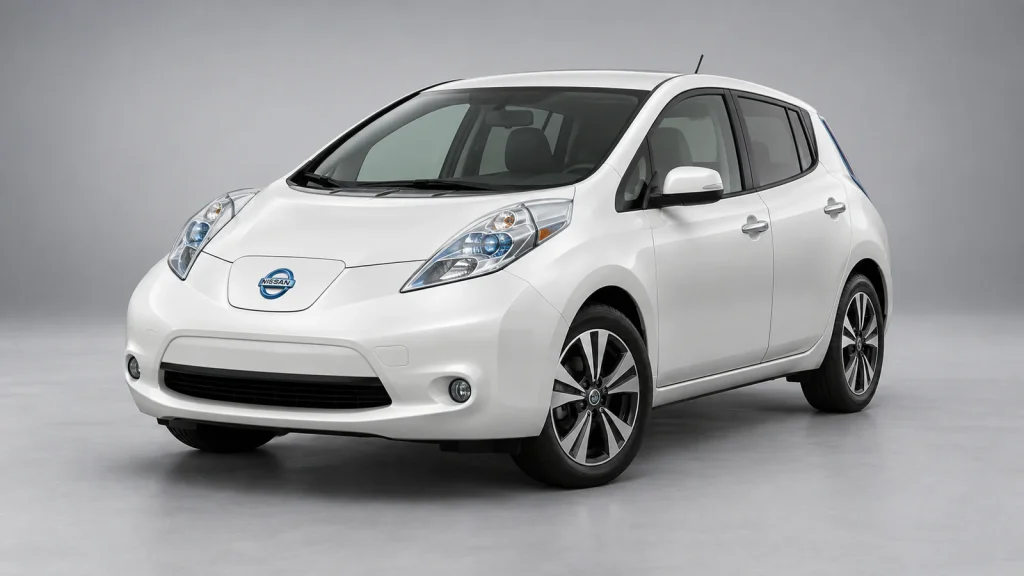
If you are checking a used Nissan Leaf, this hub is the starting point. It is built to gather the practical questions a buyer or owner actually has: what usually goes wrong, which year windows deserve caution, what warning signs matter, and what to check before money changes hands.
The Nissan Leaf is tracked here as a electric hatchback coverage hub. This page is a researched coverage page, not a final reliability verdict. Specific defect claims should come from sourced child pages, not guesswork.
Before buying or ignoring symptoms, verify open recalls by VIN, scan for stored OBD codes, check service history, and use any linked CarFaultIQ fault or symptom pages to decide the next practical step.
Official evidence for this model
Coverage below spans the explicitly mapped model years. Records do not apply to every model year or configuration.
US safety recalls
20 distinct official identifiers · US
Campaigns matched to recorded model years. Only an official VIN check can confirm whether an individual vehicle is affected.
- 26V425000 — model years 2026
Nissan North America, Inc. (Nissan) is recalling certain 2026 LEAF vehicles. The outer rear seat belt automatic locking retractors (ALR) may deactivate early, which can prevent a child restraint system (CRS) from securing properly. As such, these vehicles fail to comply with the requirements of…
- 26V188000 — model years 2026
Nissan North America, Inc. (Nissan) is recalling certain 2026 LEAF vehicles. The high voltage battery may have internal damage that can cause a short circuit within the battery module.
- 25V655000 — model years 2021, 2022
Nissan North America, Inc. (Nissan) is recalling certain 2021-2022 LEAF vehicles equipped with a Level 3 quick charging port. The lithium-ion battery may overheat during Level 3 charging.
Manufacturer communications / TSBs
317 distinct official identifiers · US
Manufacturer service communications are not safety recalls and do not prove that every vehicle has the described condition.
- 11034255 — model years 2019, 2020, 2021, 2022
*****Dealer Announcement***** Nissan is committed to delivering the highest levels of product quality and customer satisfaction. In support of this commitment, Nissan is implementing a Lithium-ion Battery Post-Remedy Program for certain Model Year 2019–2022 Nissan LEAF vehicles that were previously remedied under voluntary safety recall…
- 11031704 — model years 2011, 2012, 2013, 2014, 2015, 2016, 2017, 2018, 2019, 2020, 2021, 2022, 2023, 2024, 2025, 2026
CERTIFICATION LABEL AND VIN PLATE REPLACEMENT SERVICE INFORMATION Because of collision damage or other vehicle repair, a replacement “Certification Label” or “VIN Plate/Label” may be needed. HINT: Certification Label = FMVSS (Federal Motor Vehicle Safety Standards) label. These items may be available from Nissan by…
- 11031705 — model years 2011, 2012, 2013, 2014, 2015, 2016, 2017, 2018, 2019, 2020, 2021, 2022, 2023, 2024, 2025, 2026
CERTIFICATION LABEL AND VIN PLATE REPLACEMENT SERVICE INFORMATION Because of collision damage or other vehicle repair, a replacement “Certification Label” or “VIN Plate/Label” may be needed. HINT: Certification Label = FMVSS (Federal Motor Vehicle Safety Standards) label. These items may be available from Nissan by…
US defect investigations
5 distinct official identifiers · US
An investigation records a regulator review of a suspected defect. It is not automatically a finding or a recall.
- DP22005 — model years 2011, 2012, 2013, 2014, 2015, 2016, 2017, 2018, 2019, 2020, 2021, 2022
NHTSA received a petition on or about July 18, 2022, requesting that Federal Motor Vehicle Safety Standard (FMVSS) 141 be applied to all electric and hybrid vehicles operating in the United States. The petition can be reviewed at NHTSA.gov under ODI Number 11486072. FMVSS 141…
- PE19015 — model years 2011, 2012
Preliminary Evaluation (PE) 19-015 was opened as a result of Defect Petition (DP) 19-002 which alleged that model year (MY) 2011 and 2012 Nissan Leaf were affected by the same defect addressed in an earlier recall, NHTSA Safety Recall 16V-244, but were not included in…
- DP19002 — model years 2011, 2012
A defect petition (see DP19-002) was received July 23, 2019 alleging that the occupant classification system (OCS) sensor (mat) in model year (MY) 2011 Nissan Leaf vehicles is defective and affects the proper deployment of the passenger front air bag. The petitioner provided a list…
Canadian recalls
17 distinct official identifiers · CA
Canadian-market records remain separate from US campaigns. Confirm applicability with Transport Canada and the manufacturer.
- 2026324 — model years 2026
Issue: On certain vehicles, the rear outboard seat belts may contain defective automatic locking retractors (ALR). As a result, the seat belts may not properly lock to secure a child seat. Note: The vehicle's lower universal anchorage system (UAS) is not affected by this defect…
- 2026145 — model years 2026
Issue: On certain vehicles, a problem inside the high-voltage battery could cause a short circuit. If this happens, the high-voltage battery could overheat. Safety Risk: A short circuit in the high-voltage battery can create a fire risk, even while the vehicle is parked and turned…
- 2025523 — model years 2021, 2022
Issue: On certain vehicles, the high-voltage battery could overheat while using level 3 quick charging. As a result, the battery could create smoke or heat, which can melt or damage the battery and nearby parts. Note: This recall is an expansion of Transport Canada recall…
US owner complaint reports
1,092 distinct reports · US
Distinct ODI complaint identifiers, deduplicated across component and product rows. Reports are allegations, not confirmed defects, failure rates or reliability scores.
- ELECTRICAL SYSTEM: 503 reports
- SERVICE BRAKES: 233 reports
- UNKNOWN OR OTHER: 162 reports
A report can name several components. Do not add component totals together.
Evidence is served from a locally stored official-source snapshot. No external API is called to render this page. These records do not replace inspection or diagnosis. Contains information licensed under the Open Government Licence – Canada.