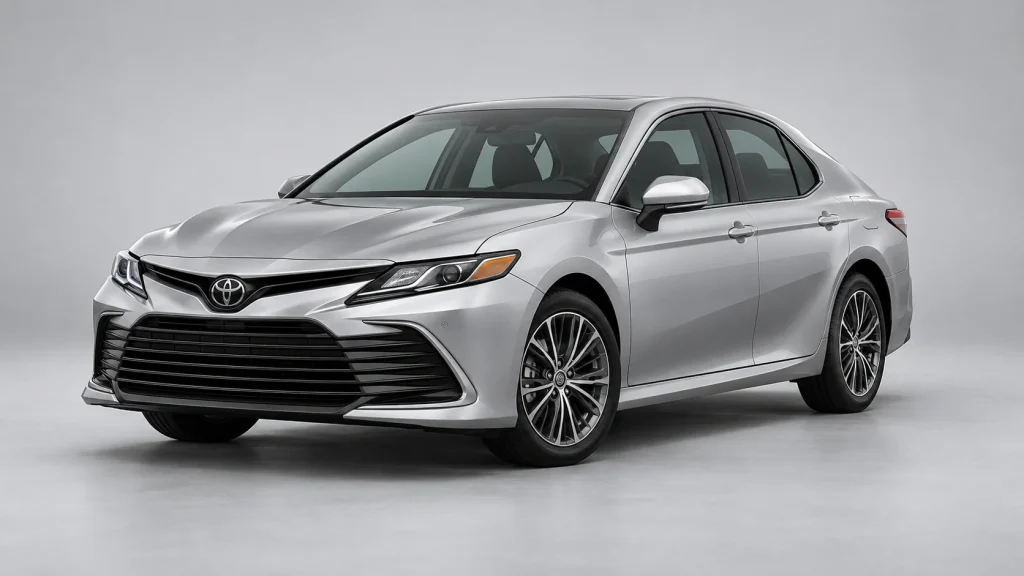
Owner complaints for this model most often concern:
Speed control & accelerator6,106 (14.4%)Official recall records for this system: 4, covering model years 1996–2010.
Engine4,748 (11.2%)Official recall records for this system: 7, covering model years 1998–2020.
Brakes4,298 (10.1%)Official recall records for this system: 11, covering model years 1997–2019.
Where a mileage was given (20,394 reports), it averaged 62,268 miles.
These are counts of records held, not a failure rate: no vehicles-in-service figure exists in this data, so no reliability score can be derived from it.
Give these systems extra attention Model-specific · evidence-led
These systems are listed first because owner complaints for the Toyota Camry most often concern them. That is where records concentrate — it is not a finding that any individual car has a fault.
Speed control & accelerator6,106 complaints classified here (14.4% of classifications)
Check the accelerator pedal returns freely and the engine speed drops promptly when you lift off.
Test the cruise control if fitted.
Engine4,748 complaints classified here (11.2% of classifications)
Check for oil leaks and the oil level; ask how often it needs topping up between changes.
Listen for knocking or ticking at idle and under light acceleration.
Brakes4,298 complaints classified here (10.1% of classifications)
Check the pedal feels firm and the car stops straight without pulsing or grinding.
Check the brake and ABS warning lamps go out after starting.
Powertrain (transmission & drivetrain)3,302 complaints classified here (7.8% of classifications)
Check for delayed or harsh shifts, slipping or shudder, both cold and when warm.
Ask when the transmission fluid was last serviced, and for any transmission repair records.
Good practice for any used car Generic
Documents & seller questions
Run the VIN through the official recall lookup (NHTSA in the US, Transport Canada in Canada) and ask for proof that open recalls were completed.
Ask for service records, and when the transmission fluid, coolant and brake fluid were last changed.
Ask whether the car has been in a collision or a flood, and whether any warning light has been on recently.
Before starting
Arrange to see it with the engine cold — ask the seller not to warm it up first.
Look for uneven panel gaps, mismatched paint and fresh underseal, which can indicate repair work.
Cold start
Watch every warning lamp light up with the ignition on, then go out once the engine runs.
Listen for rattles, knocks or a rough idle in the first minute, and look for smoke from the exhaust.
Engine bay
Check the oil and coolant levels and condition; note any milky oil or oily coolant.
Look for fresh leaks, wet hoses and signs of recent cleaning that could hide leaks.
Test drive
Drive at town and highway speeds; note hesitation, vibration, pulling or unusual noise.
Check that every gear engages smoothly, including reverse, from cold and when warm.
Underbody & leaks
After the drive, look under the car for fresh drips.
Have a mechanic check the underside for corrosion, damaged components and leaks on a lift.
An inspection checklist, not a diagnosis. A pre-purchase inspection by an independent mechanic is the reliable way to assess a specific car.
Short answer
Toyota Camry coverage spans 1995-2026 with structured year, market, configuration, evidence-state, and inspection context. It is not a reliability score.
Key takeaways
Supported years: 1995-2026.
Structured variants: 356.
Tier: Tier A.
Recall applicability must be checked by VIN.
Complaint signals do not prove defects or frequency.
CarFaultIQ's structured records for the Toyota Camry span six generations from 1997 to the current model, in four- and six-cylinder configurations with a hybrid powertrain recorded alongside the gasoline versions. All six generations have their own dedicated coverage page, making the Camry one of the most completely mapped nameplates on this site.
The Toyota Camry hub gathers everything CarFaultIQ tracks for this model: common problems by year, the strongest and riskiest years to buy, and what a used-car inspection should focus on.
A long-running reliability benchmark with two clear caution zones: 2007–2011 oil consumption on the 2.4L engine and early-generation transmission hesitation complaints.
Start with the common-problems page below, then cross-check any candidate car against the symptom and OBD-code pages it links to.
Evidence-backed model intelligence
Toyota Camry diagnostic overview
Structured coverage spans 1995-2026. Use the exact model year and symptoms when narrowing a fault.
Vehicle coverage
Powertrain evidence: CNG and Regular Gasoline
Electrification: Hybrid
Drivetrain coverage: AWD and FWD
Start with the evidence you have
A symptom and an OBD code are separate evidence channels. Use either one; do not assume a stored code proves a particular repair.
Coverage below spans the explicitly mapped model years. Records do not apply to every model year or configuration.
US safety recalls
57 distinct official identifiers · US
Campaigns matched to recorded model years. Only an official VIN check can confirm whether an individual vehicle is affected.
25V028000 — model years 2018
Toyota Motor Engineering & Manufacturing (Toyota) is recalling certain 2018 Camry, 2019 Lexus NX300, and 2019 RX350L vehicles. The low-pressure fuel pump inside the fuel tank may fail.
24V128000 — model years 2023, 2024
Toyota Motor Engineering & Manufacturing (Toyota) is recalling certain 2023-2024 Camry and Camry Hybrid vehicles. The second-row center and right-side seats may have insufficiently welded head restraint brackets. As such, these vehicles fail to comply with the requirements of Federal Motor Vehicle Safety Standard number…
23V865000 — model years 2020, 2021, 2022
Toyota Motor Engineering & Manufacturing (Toyota) is recalling certain 2020-2021 Avalon, Avalon Hybrid, Corolla, Highlander, Highlander Hybrid, RAV4, RAV4 Hybrid, Lexus ES350, Lexus RX350, Lexus RX450H, 2021 Sienna Hybrid, Lexus ES250, 2020-2022 Camry, Camry Hybrid, and ES300H vehicles. A short circuit may develop in the…
Manufacturer service communications are not safety recalls and do not prove that every vehicle has the described condition.
11032472 — model years 2018, 2019, 2020, 2021, 2022, 2023, 2024
Some 2018 – 2024 model year Camry and 2018 – 2026 model year Camry Hybrid vehicles may exhibit the weatherstrip on the panoramic roof center glass peeling on the edges of the glass.
11032467 — model years 2021, 2022, 2023, 2024
Some customers may experience a rough running engine with a MIL ON P140018 DTC. Upon further inspection, a loose C90/C27 connector pin at the EGR valve may be found. To correct this concern, please reference the repair section of this TSB.
11029896 — model years 2018, 2019, 2020, 2021, 2022, 2023, 2024
OBSOLETE NOTICE February 27, 2026: This bulletin is no longer applicable and is now obsolete.
An investigation records a regulator review of a suspected defect. It is not automatically a finding or a recall.
EA12006 — model years 2007, 2008, 2009
On October 10, 2012, Toyota initiated a safety recall of approximately 2.5 million U.S. vehicles involving the following models and model years:2007-2009 Camry and Camry Hybrid, 2009 Corolla and Corolla Matrix, 2008 Highlander and Highlander Hybrid, 2007-2009 RAV4, 2008-2009 Scion xB and xD, 2008-2009 Sequoia,…
PE12002 — model years 2007, 2008, 2009
ODI has identified certain Toyota vehicles experiencing a higher rate of fire and thermal event incidents among all Toyota vehicles that use the same power window master switch design.They include a total of approximately 1.4 million model year (MY) 2007 through 2009 Camry, Camry Hybrid,…
EA07010 — model years 2007, 2008
THE DRIVER SIDE FLOOR MAT WILL NOT INTERFERE WITH THE THROTTLE PEDAL IF PROPERLY SECURED USING THE RETAINING HOOKS PROVIDED BY TOYOTA.HOWEVER, IF THE ALL WEATHER MAT IS UNSECURED AND MOVES FORWARD FROM ITS INTENDED POSITION IT CAN ENTRAP THE THROTTLE PEDAL AT THE FULLY…
Canadian-market records remain separate from US campaigns. Confirm applicability with Transport Canada and the manufacturer.
2026383 — model years 2025, 2026
Issue: On certain vehicles, a software problem could cause the combination meter in the instrument cluster not to display when the vehicle is started. As a result, the turn signals and hazard lights may not work. Additionally, you may not be able to see certain…
2025594 — model years 2025, 2026
Multiple source assertions are retained for this identifier. Consult the official record for configuration-specific details.
2025469 — model years 2025
Multiple source assertions are retained for this identifier. Consult the official record for configuration-specific details.
Distinct ODI complaint identifiers, deduplicated across component and product rows. Reports are allegations, not confirmed defects, failure rates or reliability scores.
VEHICLE SPEED CONTROL: 2,593 reports
ENGINE: 1,481 reports
UNKNOWN OR OTHER: 1,466 reports
A report can name several components. Do not add component totals together.
Evidence is served from a locally stored official-source snapshot. No external API is called to render this page. These records do not replace inspection or diagnosis. Contains information licensed under the Open Government Licence – Canada.
Every Camry generation from 1997 onward has its own coverage page — 1997–2001, 2002–2006, 2007–2011, 2012–2017, 2018–2024 and 2025–2026 — each showing only the Fault, recall and complaint records that actually apply to that span. Because the documented issues concentrate so heavily in the sixth and seventh generations, those two pages currently carry the most detail.
Seven Fault pages are currently linked to the Camry, and five of the seven concentrate on a single generation: the sixth (2007–2011), covering an A/C condenser leak, VSC light and throttle body, piston-ring oil burning, transmission hesitation, and a dashboard record. Two more — an A/C condenser leak and a water pump leak — belong to the seventh generation (2012–2017). No Fault page currently covers the fourth, fifth, eighth or ninth generations, and none applies to the model as a whole.
CarFaultIQ holds records for a substantial number of official recall campaigns tied to the Camry, across eight systems including seats, wheels, air bags, gasoline fuel delivery, engine and cooling, hydraulic brakes and equipment labelling. Nearly all of the campaigns in CarFaultIQ's current records concern the 2018–2025 model years — the eighth and ninth generations — rather than the earlier cars, and most are limited to one or two specific model years. A VIN check is the reliable way to confirm applicability on any individual Camry.
Eight complaint categories recur in aggregated owner reports for the Camry, most consistently vehicle speed control, structure, power train and air bags, tracked continuously from 2000 through the newest model years. These are owner-filed reports rather than confirmed failures, and a category's persistence over time is a signal of where reporting has concentrated, not a measure of how often anything actually fails.
Used-car checks
No structured used-car checks are verified on this model hub yet.
Recall/safety notes
No hand-written safety notes have been added to this hub. Official recall, bulletin and investigation records held for this vehicle are listed under documented evidence on this page — the absence of a note here does not mean no records exist. Always confirm by VIN.
The Common Problems and Best & Worst Years pages below draw together what is documented across the nameplate. For a specific car, its generation page narrows the evidence to the correct years, and a VIN recall check remains the most reliable single step given how recent most of the campaign record is.