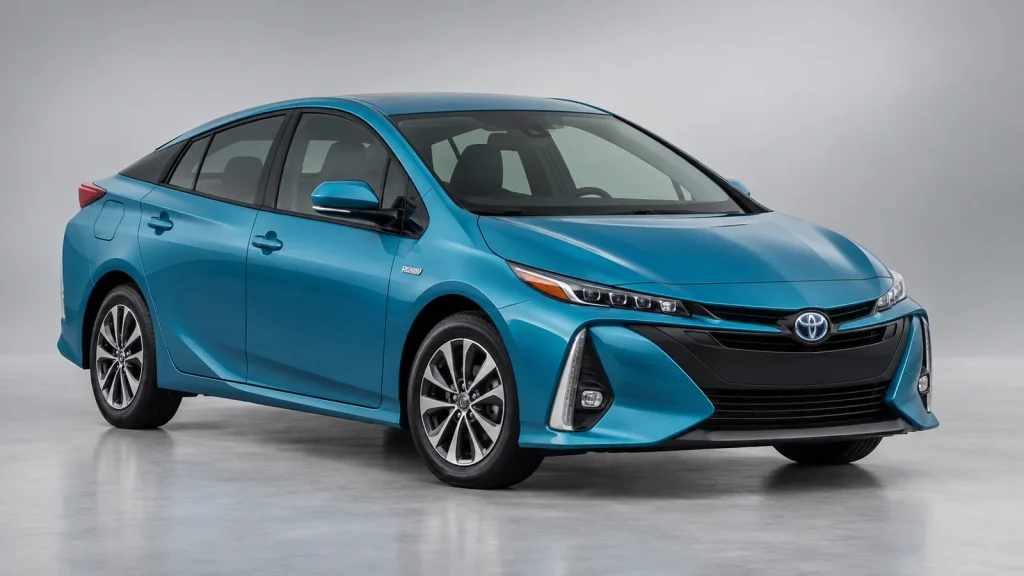
The Toyota Prius Prime page is a Tier B CarFaultIQ model hub. It covers supported years, market scope, structured configurations, and diagnostic navigation without creating one page per year or trim.
Supported years and market coverage
Structured coverage spans 2017-2023 across 7 canonical model-year record(s). Market coverage includes United States.
Powertrain and configuration coverage
Imported fuel labels include Electricity|X*|Regular Gasoline. Electrification labels include Electric. Detailed variants remain in the structured selected-year module.
Evidence limitations
This is a structured factual model hub. Local recall or complaint evidence is limited or not safely matched, so the page does not claim common problems, reliability trends, best years, worst years, recall absence, complaint absence, or repair costs.
Diagnostic navigation
- No-start diagnostic path – contextual diagnostic reference, not a model-specific incidence claim.
- Acceleration hesitation checks – contextual diagnostic reference, not a model-specific incidence claim.
- Brake pedal feel checks – contextual diagnostic reference, not a model-specific incidence claim.
- Check engine light guidance – contextual diagnostic reference, not a model-specific incidence claim.
- Battery warning light guidance – contextual diagnostic reference, not a model-specific incidence claim.
- P0300 misfire reference – contextual diagnostic reference, not a model-specific incidence claim.
- P0420 catalyst reference – contextual diagnostic reference, not a model-specific incidence claim.
- Pre-purchase inspection guide – contextual diagnostic reference, not a model-specific incidence claim.
- OBD code reading guide – contextual diagnostic reference, not a model-specific incidence claim.
Used-car inspection priorities
- Check cold-start behavior, warning lights, visible leaks, tire wear, brake feel, and stored diagnostic codes.
- Confirm the exact model year and configuration before applying any recall or diagnostic assumption.
- Use the official recall lookup for VIN-specific campaign applicability.
- Use a qualified inspection for purchase decisions; this page is an evidence hub, not a repair manual.
Source notes
Structured coverage comes from the imported CarFaultIQ v3.1 vehicle database. Recall and complaint signals come from local evidence tables created from traceable NHTSA harvester snapshots. Complaint narratives are not imported into public content.
Frequently asked questions
Does this page rank the best or worst Toyota Prius Prime years?
No. It presents structured coverage and evidence limitations without ranking years, reliability, safety, or repair cost.
Does a recall row mean every Toyota Prius Prime is affected?
No. Recall applicability must be checked by VIN and campaign scope.
Are complaint signals confirmed defects?
No. They are owner-reported signals for editorial review and do not prove causation.
Toyota Prius Prime 2023–2024
No verified model-specific fault records for 2023–2024 yet.
Structured vehicle data
These fields are read live from the imported v3.1 vehicle tables. They are configuration coverage, not reliability or safety conclusions.
- Fuel types: Electricity, Regular Gasoline
- Electrification: Electric
- Drivetrain: FWD
- Total structured variants: 18
2025 structured configurations
| Market | Trim/source label | Fuel | Electrification | Drive | Transmission |
|---|---|---|---|---|---|
| US | Se | Electricity | Electric, Plug-in Hybrid | Not specified | Continuously Variable |
| US | Xse | Electricity | Electric, Plug-in Hybrid | Not specified | Continuously Variable |
Official evidence for this model
Coverage below spans the explicitly mapped model years. Records do not apply to every model year or configuration.
US safety recalls
6 distinct official identifiers · US
Campaigns matched to recorded model years. Only an official VIN check can confirm whether an individual vehicle is affected.
- 26V049000 — model years 2023, 2024
Toyota Motor Engineering & Manufacturing (Toyota) is recalling certain 2023-2024 Prius Prime, 2023-2026 Prius, and 2025-2026 Prius Plug-in Hybrid vehicles. Water may enter the rear door switch and cause a short circuit, allowing an unlocked rear door to open unexpectedly.
- 25V744000 — model years 2023, 2024
Toyota Motor Engineering & Manufacturing (Toyota) is recalling certain 2022-2026 Toyota, Lexus, and Subaru Solterra vehicles equipped with a Panoramic View Monitor (PVM) system. Please see the recall report for a complete list of models. A software error may cause the rearview camera to freeze…
- 24V548000 — model years 2023, 2024
Gulf States Toyota, Inc. (GST) is recalling certain Toyota 2023 GR Supra, 2024 4 Runner, Corolla, Grand Highlander, Grand Highlander Hybrid, Land Cruiser Hybrid, Tacoma, Tacoma Hybrid, 2023-2024 BZ4X, Corolla Cross Hybrid, GR Corolla, GR86, Highlander, Highlander Hybrid, Prius, Prius Prime, Sequoia Hybrid, Tundra, Tundra…
Manufacturer communications / TSBs
331 distinct official identifiers · US
Manufacturer service communications are not safety recalls and do not prove that every vehicle has the described condition.
- 11029896 — model years 2023, 2024
OBSOLETE NOTICE February 27, 2026: This bulletin is no longer applicable and is now obsolete.
- 11028726 — model years 2020, 2021, 2022
OBSOLETE NOTICE January 30, 2026: This bulletin is now obsolete. Please see T-SB-0001-26.
- 11028722 — model years 2020, 2021, 2022
Some 2018 – 2024 model year Toyota vehicles equipped with a Premium Audio with Dynamic Navigation System require a Special Service Tool (SST) USB flash drive to update the map, points of interest, and system software.
US defect investigations
1 distinct official identifiers · US
An investigation records a regulator review of a suspected defect. It is not automatically a finding or a recall.
- DP22005 — model years 2017, 2018, 2019, 2020, 2021, 2022
NHTSA received a petition on or about July 18, 2022, requesting that Federal Motor Vehicle Safety Standard (FMVSS) 141 be applied to all electric and hybrid vehicles operating in the United States. The petition can be reviewed at NHTSA.gov under ODI Number 11486072. FMVSS 141…
Canadian recalls
7 distinct official identifiers · CA
Canadian-market records remain separate from US campaigns. Confirm applicability with Transport Canada and the manufacturer.
- 2026034 — model years 2023, 2024, 2025
Issue: On certain vehicles, water could leak into the rear door handle(s) and cause the door opener switch(es) to short circuit. If this happens, the rear door(s) could open unexpectedly while driving. Note: This is an expansion of Transport Canada recall no. 2024-228. Vehicles repaired…
- 2025594 — model years 2023, 2024, 2025
Multiple source assertions are retained for this identifier. Consult the official record for configuration-specific details.
- 2024228 — model years 2023, 2024
Issue: On certain vehicles, water could leak into the rear door handle(s) and could cause the door opener switch(es) to short circuit. If this happens, the rear door(s) could open unexpectedly while driving. Safety Risk: A door that opens while driving could create a risk…
US owner complaint reports
116 distinct reports · US
Distinct ODI complaint identifiers, deduplicated across component and product rows. Reports are allegations, not confirmed defects, failure rates or reliability scores.
- ELECTRICAL SYSTEM: 23 reports
- VISIBILITY/WIPER: 17 reports
- UNKNOWN OR OTHER: 13 reports
A report can name several components. Do not add component totals together.
Evidence is served from a locally stored official-source snapshot. No external API is called to render this page. These records do not replace inspection or diagnosis. Contains information licensed under the Open Government Licence – Canada.