 CarFault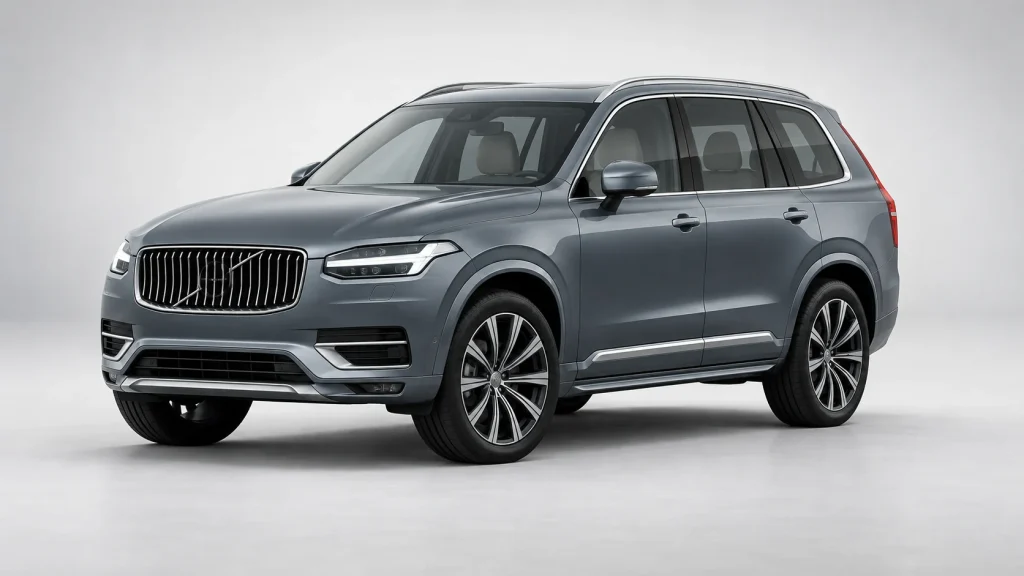
If you are checking a used Volvo XC90, this hub is the starting point. It is built to gather the practical questions a buyer or owner actually has: what usually goes wrong, which year windows deserve caution, what warning signs matter, and what to check before money changes hands.
The Volvo XC90 is tracked here as a midsize luxury SUV coverage hub. This page is a researched coverage page, not a final reliability verdict. Specific defect claims should come from sourced child pages, not guesswork.
Before buying or ignoring symptoms, verify open recalls by VIN, scan for stored OBD codes, check service history, and use any linked CarFaultIQ fault or symptom pages to decide the next practical step.
Volvo XC90 2003–2014
No verified model-specific fault records for 2003–2014 yet.
Official evidence for this model
Coverage below spans the explicitly mapped model years. Records do not apply to every model year or configuration.
US safety recalls
35 distinct official identifiers · US
Campaigns matched to recorded model years. Only an official VIN check can confirm whether an individual vehicle is affected.
- 25V908000 — model years 2023, 2024, 2025
Volvo Car USA, LLC (Volvo Car) is recalling certain 2021-2025 XC40, 2022 V90, 2022-2024 C40BEV, 2022-2025 S90, V90CC, XC60, 2023-2025 S60, V60, V60CC, XC90, and 2025 EC40, and EX40 vehicles. The rearview camera image may not display when the vehicle is placed in reverse. As…
- 25V282000 — model years 2023, 2024, 2025
Volvo Car USA, LLC (Volvo Car) is recalling certain 2021-2025 XC40, 2022 V90, 2022-2025 S90, V90CC, C40, XC60, 2023-2025 S60, V60, V60CC, XC90, and 2025 EC40 and EX40 vehicles. The rearview camera image may not display when the vehicle is placed in reverse. As such,…
- 25V179000 — model years 2020, 2021, 2022
Volvo Car USA, LLC (Volvo Car) is recalling certain 2020-2021 S90, 2020-2022 S60, V60, XC60, XC90, and 2022 V90 plug-in hybrid vehicles. The high-voltage battery may experience a short circuit within the battery module when the battery is fully charged and the vehicle is parked.
Manufacturer communications / TSBs
1,354 distinct official identifiers · US
Manufacturer service communications are not safety recalls and do not prove that every vehicle has the described condition.
- 11034998 — model years 2022
This is a Tech Journal - Text only no attachments - If a customer experiences a “Propulsion System Performance” message in the DIM with diagnostic trouble code IEM P060700, often in combination with IEM P061A00, please follow the instructions under "Service".
- 11034989 — model years 2016
This is a Technical Journal: Plus 2 attachments 1- TJI-497587-1 and 1 MP4 Speaker Grill -It may be possible for the rear door lock switch to get stuck in the speaker grille. This can lead to a drained battery. Applies only for cars with Premium…
- 11033746 — model years 2016, 2017, 2018, 2019, 2020, 2021
This is a Technical Journal: Text plus 1 .jpg attachment - If remote control key is not detected by the car and shows message in DIM "Car key not found" or if functions such as lock/unlock are not working, please follow advice for detecting key
US defect investigations
6 distinct official identifiers · US
An investigation records a regulator review of a suspected defect. It is not automatically a finding or a recall.
- DP22005 — model years 2016, 2017, 2018, 2019, 2020, 2021, 2022
NHTSA received a petition on or about July 18, 2022, requesting that Federal Motor Vehicle Safety Standard (FMVSS) 141 be applied to all electric and hybrid vehicles operating in the United States. The petition can be reviewed at NHTSA.gov under ODI Number 11486072. FMVSS 141…
- PE10025 — model years 2004, 2005
Volvo acknowledged a problem affecting some subject vehicles involving water seepage into the plenum box area in the engine compartment.When this occurs water may enter into the interior / passenger compartment and track along the wiring harness for the Central Electronic Module (CEM), the device…
- PE09039 — model years 2004
VOLVO HAS DETERMINED THAT DUE TO EXPOSURE TO CERTAIN ENVIRONMENTAL CONDITIONS (HOT CLIMATES AND TEMPERATURE CYCLING) AND VARYING FUEL QUALITY, THE FUEL PUMP FLANGE IN THE XC90 VEHICLES CAN DEVELOP CRACKS.OWNERS MAY NOTICE FUEL SMELL AND/OR FUEL SEEPAGE.DUE TO SIMILAR MATERIAL USAGE, THIS ISSUE ALSO…
Canadian recalls
36 distinct official identifiers · CA
Canadian-market records remain separate from US campaigns. Confirm applicability with Transport Canada and the manufacturer.
- 2025718 — model years 2023, 2024, 2025
Multiple source assertions are retained for this identifier. Consult the official record for configuration-specific details.
- 2025471 — model years 2026
Multiple source assertions are retained for this identifier. Consult the official record for configuration-specific details.
- 2025319 — model years 2022, 2023, 2024, 2025, 2026
Multiple source assertions are retained for this identifier. Consult the official record for configuration-specific details.
US owner complaint reports
1,510 distinct reports · US
Distinct ODI complaint identifiers, deduplicated across component and product rows. Reports are allegations, not confirmed defects, failure rates or reliability scores.
- ELECTRICAL SYSTEM: 418 reports
- ENGINE: 235 reports
- POWER TRAIN:AUTOMATIC TRANSMISSION: 185 reports
A report can name several components. Do not add component totals together.
Evidence is served from a locally stored official-source snapshot. No external API is called to render this page. These records do not replace inspection or diagnosis. Contains information licensed under the Open Government Licence – Canada.