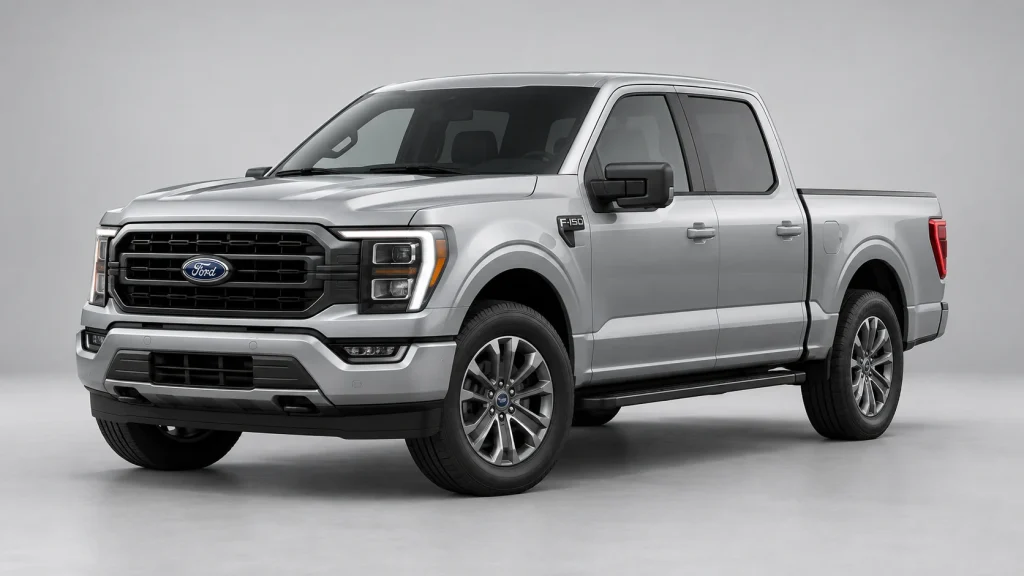
Owner complaints for this model most often concern:
Powertrain (transmission & drivetrain)17,810 (19.7%)Official recall records for this system: 63, covering model years 1997–2026.
Engine13,468 (14.9%)Official recall records for this system: 18, covering model years 1997–2025.
Brakes7,339 (8.1%)Official recall records for this system: 36, covering model years 1997–2025.
Where a mileage was given (42,462 reports), it averaged 76,448 miles.
These are counts of records held, not a failure rate: no vehicles-in-service figure exists in this data, so no reliability score can be derived from it.
Give these systems extra attention Model-specific · evidence-led
These systems are listed first because owner complaints for the Ford F-150 most often concern them. That is where records concentrate — it is not a finding that any individual car has a fault.
Powertrain (transmission & drivetrain)17,810 complaints classified here (19.7% of classifications)
Check for delayed or harsh shifts, slipping or shudder, both cold and when warm.
Ask when the transmission fluid was last serviced, and for any transmission repair records.
Engine13,468 complaints classified here (14.9% of classifications)
Check for oil leaks and the oil level; ask how often it needs topping up between changes.
Listen for knocking or ticking at idle and under light acceleration.
Brakes7,339 complaints classified here (8.1% of classifications)
Check the pedal feels firm and the car stops straight without pulsing or grinding.
Check the brake and ABS warning lamps go out after starting.
Electrical system7,296 complaints classified here (8.1% of classifications)
Test every electrical item: windows, locks, lights, infotainment, instrument cluster and charging ports.
Ask about battery replacement history and any recurring electrical faults.
Good practice for any used car Generic
Documents & seller questions
Run the VIN through the official recall lookup (NHTSA in the US, Transport Canada in Canada) and ask for proof that open recalls were completed.
Ask for service records, and when the transmission fluid, coolant and brake fluid were last changed.
Ask whether the car has been in a collision or a flood, and whether any warning light has been on recently.
Before starting
Arrange to see it with the engine cold — ask the seller not to warm it up first.
Look for uneven panel gaps, mismatched paint and fresh underseal, which can indicate repair work.
Cold start
Watch every warning lamp light up with the ignition on, then go out once the engine runs.
Listen for rattles, knocks or a rough idle in the first minute, and look for smoke from the exhaust.
Engine bay
Check the oil and coolant levels and condition; note any milky oil or oily coolant.
Look for fresh leaks, wet hoses and signs of recent cleaning that could hide leaks.
Test drive
Drive at town and highway speeds; note hesitation, vibration, pulling or unusual noise.
Check that every gear engages smoothly, including reverse, from cold and when warm.
Underbody & leaks
After the drive, look under the car for fresh drips.
Have a mechanic check the underside for corrosion, damaged components and leaks on a lift.
An inspection checklist, not a diagnosis. A pre-purchase inspection by an independent mechanic is the reliable way to assess a specific car.
Short answer
Ford F-150 coverage spans 1995-2026 with structured year, market, configuration, evidence-state, and inspection context. It is not a reliability score.
Key takeaways
Supported years: 1995-2026.
Structured variants: 800.
Tier: Tier A.
Recall applicability must be checked by VIN.
Complaint signals do not prove defects or frequency.
CarFaultIQ's structured records for the Ford F-150 span five generations dating back to 1997, covering an unusually wide range of configurations — inline and V-type engines from 2.7 to 6.2 litres, in six- and eight-cylinder form, on gasoline, diesel, E85, CNG and hybrid or fully electric drivetrains depending on the model year. All five generations have their own dedicated coverage page.
The Ford F-150 hub gathers everything CarFaultIQ tracks for this model: common problems by year, the strongest and riskiest years to buy, and what a used-car inspection should focus on.
America’s best-selling truck with era-specific patterns: 5.4L Triton spark-plug issues (2004–2008) and cam phaser rattle reports on some EcoBoost years (2017–2021).
Start with the common-problems page below, then cross-check any candidate car against the symptom and OBD-code pages it links to.
Evidence-backed model intelligence
Ford F-150 diagnostic overview
Structured coverage spans 1995-2026. Use the exact model year and symptoms when narrowing a fault.
Coverage below spans the explicitly mapped model years. Records do not apply to every model year or configuration.
US safety recalls
176 distinct official identifiers · US
Campaigns matched to recorded model years. Only an official VIN check can confirm whether an individual vehicle is affected.
26V550000 — model years 2026
Ford Motor Company (Ford) is recalling certain 2026 Maverick, F-150, and Bronco Sport vehicles. Certain vehicle joints may be improperly tightened. This can lead to detached parts, unsecured cargo, degraded crash protection, electrical system failure, or a loss of vehicle stability.
26V489000 — model years 2021, 2022, 2023
Ford Motor Company (Ford) is recalling certain 2021-2023 F-150 and 2023-2026 F-250 SD vehicles equipped with 8-inch SYNC infotainment screens. A software error may cause the rearview camera image to be obstructed by the infotainment home screen menu when the vehicle is placed in reverse.…
26V402000 — model years 2021
Ford Motor Company (Ford) is recalling certain 2018-2021 Navigator, Expedition, 2020-2021 Explorer, Lincoln Aviator, and 2021 F-150 vehicles. The transmission park pawl may engage while the vehicle is in motion, resulting in park system damage.
Manufacturer service communications are not safety recalls and do not prove that every vehicle has the described condition.
11036301 — model years 2021, 2022, 2023, 2024, 2025, 2026
Some 2021-2026 F-150 vehicles may exhibit a concern of the windshield wipers not parking in the correct position on the windshield and/or over-traveling. This may be due to incorrect alignment of the wiper pivot arm on the wiper linkage assembly. Wiper pivot arms may or…
11036107 — model years 2024, 2025, 2026
Some 2025-2026 Aviator/Explorer/Expedition/F-150/Mustang Mach-E/Navigator vehicles may exhibit the hands-free BlueCruise feature intermittently/consistently unavailable when BlueCruise is active and when traveling in a "Blue Zone". Speed sign recognition may also be inaccurate. If there are no active relevant diagnostic trouble codes (DTC) present and the issue…
11036075 — model years 2023, 2024, 2025, 2026
Some of the vehicles listed in the Model Statement above may exhibit an intermittent extended crank with no relevant diagnostic trouble codes (DTCs) present. This may be due to various software parameters in the powertrain control module (PCM).
An investigation records a regulator review of a suspected defect. It is not automatically a finding or a recall.
EA26001 — model years 2015, 2016, 2017
On March 21, 2025, NHTSA’s Office of Defects Investigation (ODI) opened a Preliminary Evaluation (PE25002) to investigate instances of unexpected transmission downshifting without driver input in model year (MY) 2015-2017 Ford F-150 vehicles (subject vehicles) manufactured by Ford Motor Company (Ford). The complaints allege that,…
PE25002 — model years 2015, 2016, 2017
On March 21, 2025, NHTSA’s Office of Defects Investigation (ODI) opened this Preliminary Evaluation (PE25002) to investigate instances of unexpected transmission downshifting without driver input in model year (MY) 2015-2017 Ford F-150 vehicles (subject vehicles) manufactured by Ford Motor Company (Ford). The complaints allege that,…
PE24019 — model years 2018, 2022
On July 29, 2024, the Office of Defects Investigation (ODI) opened PE24019 to investigate complaints of low-pressure fuel pump failures in MY 2021 Ford Bronco vehicles. Some consumers reported that the failure occurred without warning while driving, resulting in a complete loss of motive power…
Canadian-market records remain separate from US campaigns. Confirm applicability with Transport Canada and the manufacturer.
2026409 — model years 2026
Issue: On a small number of trucks, the center high mount brake lamp may not have been properly attached. As a result, it could loosen and separate from the vehicle. Safety Risk: A center high mount brake lamp that detaches from the vehicle could create…
2026369 — model years 2021, 2022, 2023
Issue: Under certain conditions, a software problem could cause part of the rearview camera image to be blocked. Canadian regulations require the full rearview image to display while the transmission is in reverse gear. Note: This recall only affects vehicles equipped with an 8-inch display…
2026342 — model years 2021, 2022, 2023, 2024, 2025, 2026
Issue: This recall is for certain integrated trailer modules that were installed before delivery or purchased from a dealer as an aftermarket accessory. On certain vehicles, a software problem with the integrated trailer module (ITRM) may cause the trailer lights not to work when towing.…
Distinct ODI complaint identifiers, deduplicated across component and product rows. Reports are allegations, not confirmed defects, failure rates or reliability scores.
POWER TRAIN: 7,874 reports
ENGINE: 4,494 reports
ELECTRICAL SYSTEM: 2,946 reports
A report can name several components. Do not add component totals together.
Evidence is served from a locally stored official-source snapshot. No external API is called to render this page. These records do not replace inspection or diagnosis. Contains information licensed under the Open Government Licence – Canada.
All five F-150 generations in CarFaultIQ's coverage have their own page — 1997–2003, 2004–2008, 2009–2014, 2015–2020 and 2021–2026 — each scoped to that generation's actual Fault, recall and complaint records. Given how much the engine lineup changes across this nameplate, the generation page is the more useful starting point than this overview for any specific truck.
Seven Fault pages are currently linked to the F-150, and they cluster in two periods rather than spreading evenly across the truck's history. Four concern the twelfth and thirteenth generations (2009–2020) — a brake master cylinder concern, an intercooler condensation misfire, body panel corrosion, and 10-speed transmission shifting — plus an EcoBoost cam phaser rattle that continues into the fourteenth generation. Two older records are engine- and infotainment-specific to the eleventh generation (2004–2014). None of the seven applies to every model year, and several are tied to a particular engine rather than the truck generally.
CarFaultIQ holds records for a large number of official recall campaigns on the F-150, spanning six systems: the electrical system, hydraulic brakes, the power train, engine and cooling, steering, and equipment labelling. The pattern is heavily weighted toward the newest trucks — most of the campaigns in CarFaultIQ's current records concern the 2023–2025 model years specifically, rather than being spread across the truck's full history. Given how wide the engine and drivetrain range is on this nameplate, both the model year and the exact configuration need confirming before a campaign is assumed to apply.
Eight complaint categories recur in aggregated owner reports for the F-150, most commonly engine and engine cooling, power train, electrical system, and vehicle speed control. In CarFaultIQ's current records these categories are concentrated in the 2000s model years rather than continuing unbroken to the present. They are owner-filed allegations and evidence signals, not confirmed failure rates.
Used-car checks
No structured used-car checks are verified on this model hub yet.
Recall/safety notes
No hand-written safety notes have been added to this hub. Official recall, bulletin and investigation records held for this vehicle are listed under documented evidence on this page — the absence of a note here does not mean no records exist. Always confirm by VIN.
The Common Problems and Best & Worst Years pages below summarize what is documented across the whole nameplate. For a specific truck, start with its generation page, then confirm any recall against the VIN and use CarFaultIQ's OBD code lookup for anything not yet covered by a documented Fault.